wannacry-analysis
WannaCry From the Outside In — A Recovered Worm Payload With the Kill Switch Patched Out
This sample came to me as a file called e9c82c0f…a661.exe, labelled as WannaCry. It is WannaCry, but not the part people usually look at. It isn’t the ransomware and it isn’t the famous mssecsvc.exe dropper. It’s the small 64-bit DLL that the worm pushes into other machines over SMB, with a full copy of the worm glued to its end. In other words, it’s what one infected computer sends to the next one.
Two more things made it worth writing up. First, somebody patched the kill switch out: two bytes in the worm were replaced so that registering the famous domain no longer stops it. Second, the file is damaged. Roughly the second half of the embedded worm was overwritten with unrelated data from the disk it was recovered from, so some of the later components simply aren’t there anymore.
As with my previous writeups, everything here is static. I never ran the sample. I read the code in Ghidra, carved each stage out with dd, and only used the network to look up the Bitcoin addresses on a public blockchain explorer.
Triage
$ file e9c82c0f...a661.exe
PE32+ executable for MS Windows 5.02 (DLL), x86-64, 6 sections

$ sha256sum e9c82c0f...a661.exe
e9c82c0f40b82eb9e7fffa7600628fa5dbe6a387829ec13342bb8d75f34ea661
 The
.exe extension is misleading: this is a 64-bit DLL. The name was most likely given by whoever collected it.
A few things stood out straight away:
- It’s a DLL, not a program. A DLL can’t start on its own; something has to load it and call one of its functions.
- It has a single export,
PlayGame, and the internal name islauncher.dll. An odd, harmless-sounding name for something inside a ransomware sample. - It’s 5 MB, but the code section is tiny. Almost all of the size is in the resources.
- Only
KERNEL32.dllis imported: resource functions,CreateFileA,WriteFile,CreateProcessA, plus the C runtime. Not much, but nothing hidden either; these imports are all it needs. - The compile timestamp is 11 May 2017, the day before the WannaCry outbreak.
Stage 1 — launcher.dll
DllMain does nothing interesting
The entry point is the standard Visual Studio 2010 DLL startup code. It calls the real DllMain with reason 1 (DLL_PROCESS_ATTACH), and all DllMain does is save its own module handle in a global variable. That handle comes back in a minute.
PlayGame
The only export is three lines long:
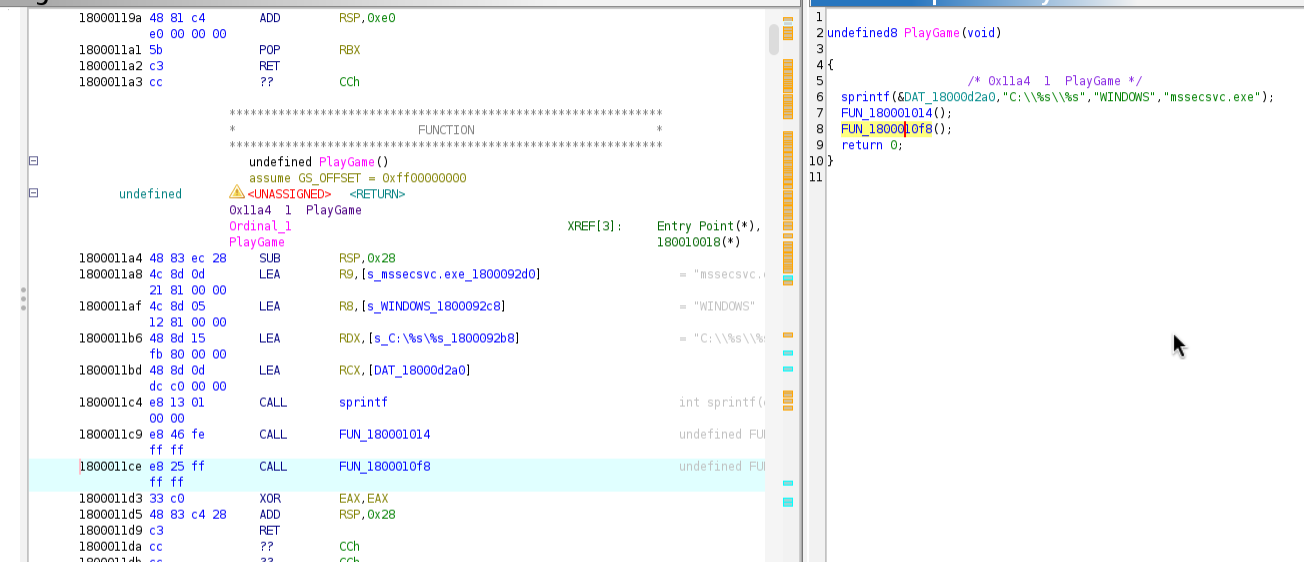 Build the path
C:\WINDOWS\mssecsvc.exe with sprintf, write a file there, run it.
The first function writes the file:
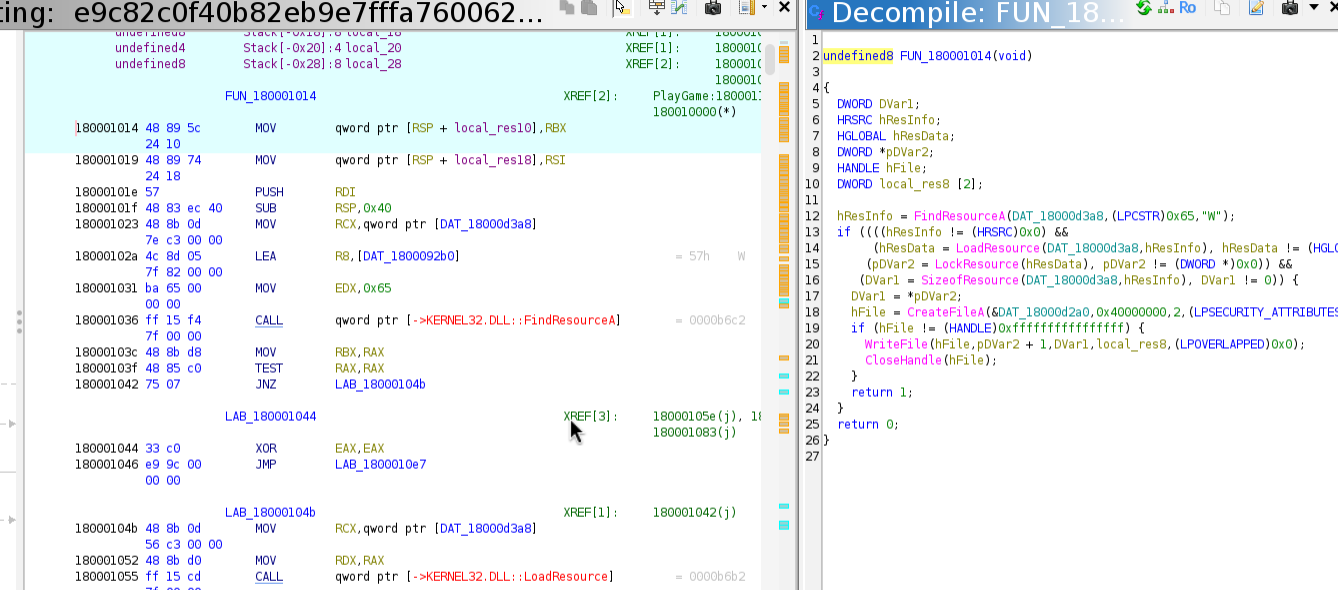
FindResourceA(hModule, 101, "W"), then LoadResource, LockResource, SizeofResource, CreateFileA and WriteFile.
This is where the saved module handle is used: it tells FindResourceA to look for the resource inside the DLL itself. The resource is type "W", ID 101 (0x65).
The interesting detail is in the last two lines. The number of bytes written is not what SizeofResource returns. It is the first 4 bytes of the resource (*pDVar2), and the data is written starting right after them (pDVar2 + 1, which for a pointer to a 32-bit value means +4 bytes). So the resource is laid out like this:
[ 4-byte size ][ the actual executable ][ padding ]
Looking at the resource in Ghidra confirms it:
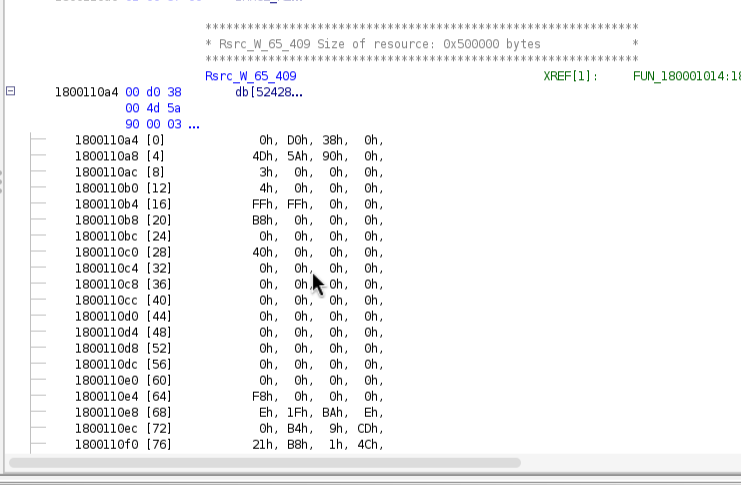
00 D0 38 00 is 0x0038D000 (3,723,264) in little-endian, and right after it comes 4D 5A, the MZ of a Windows executable. The resource itself is 0x500000 bytes; the rest is zero padding that never gets written.
The second function starts what it just wrote:
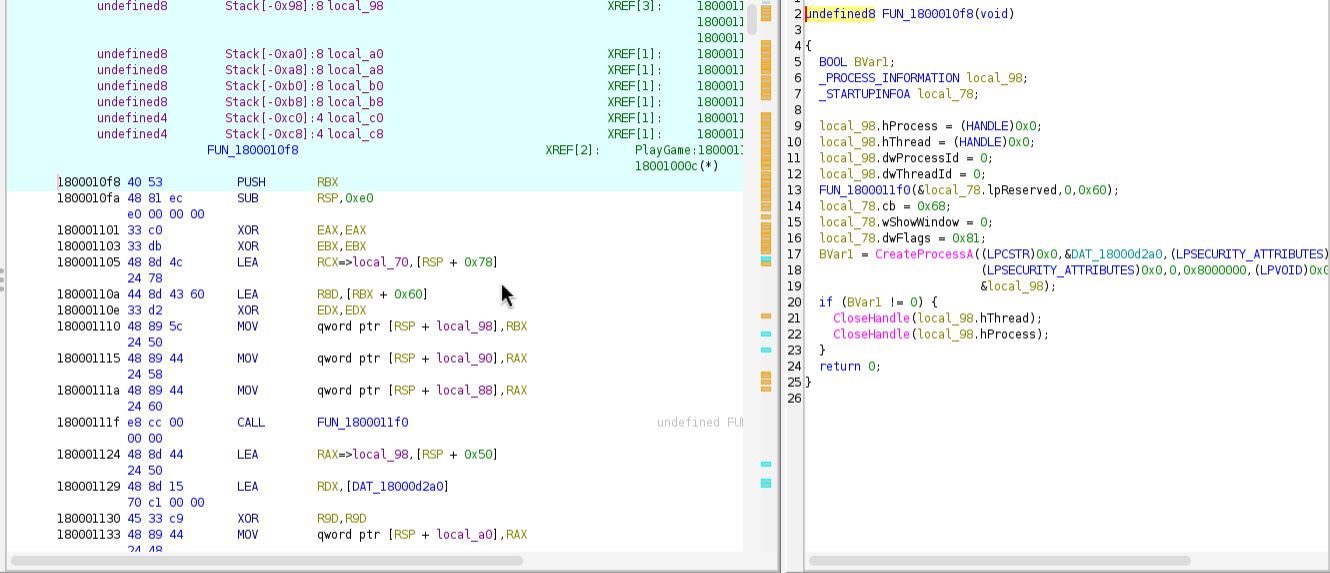
CreateProcessA with CREATE_NO_WINDOW (0x08000000), wShowWindow = 0 (SW_HIDE) and dwFlags = 0x81: no window and no busy cursor.
To get the executable out, I converted the resource address to a file offset with the section table (.rsrc starts at virtual address 0x180011000 and file offset 0xC800, so 0x1800110A4 becomes 0xC8A4), skipped the 4-byte size and copied exactly 0x38D000 bytes:
$ dd if=e9c82c0f...a661.exe of=mssecsvc.bin bs=1 skip=$((0xc8a4+4)) count=$((0x38D000))
$ file mssecsvc.bin
PE32 executable (GUI) Intel 80386, for MS Windows, 4 sections
So the DLL is 64-bit, but what it drops is a 32-bit program. That’s the second stage.
A Damaged Sample
The SHA256 of the extracted file (3f6fcccc…3e75) doesn’t match the well-known mssecsvc.exe hash. My first guess was a different configuration, but if that were the case the differences would be a handful of strings. The entropy graph showed something else:
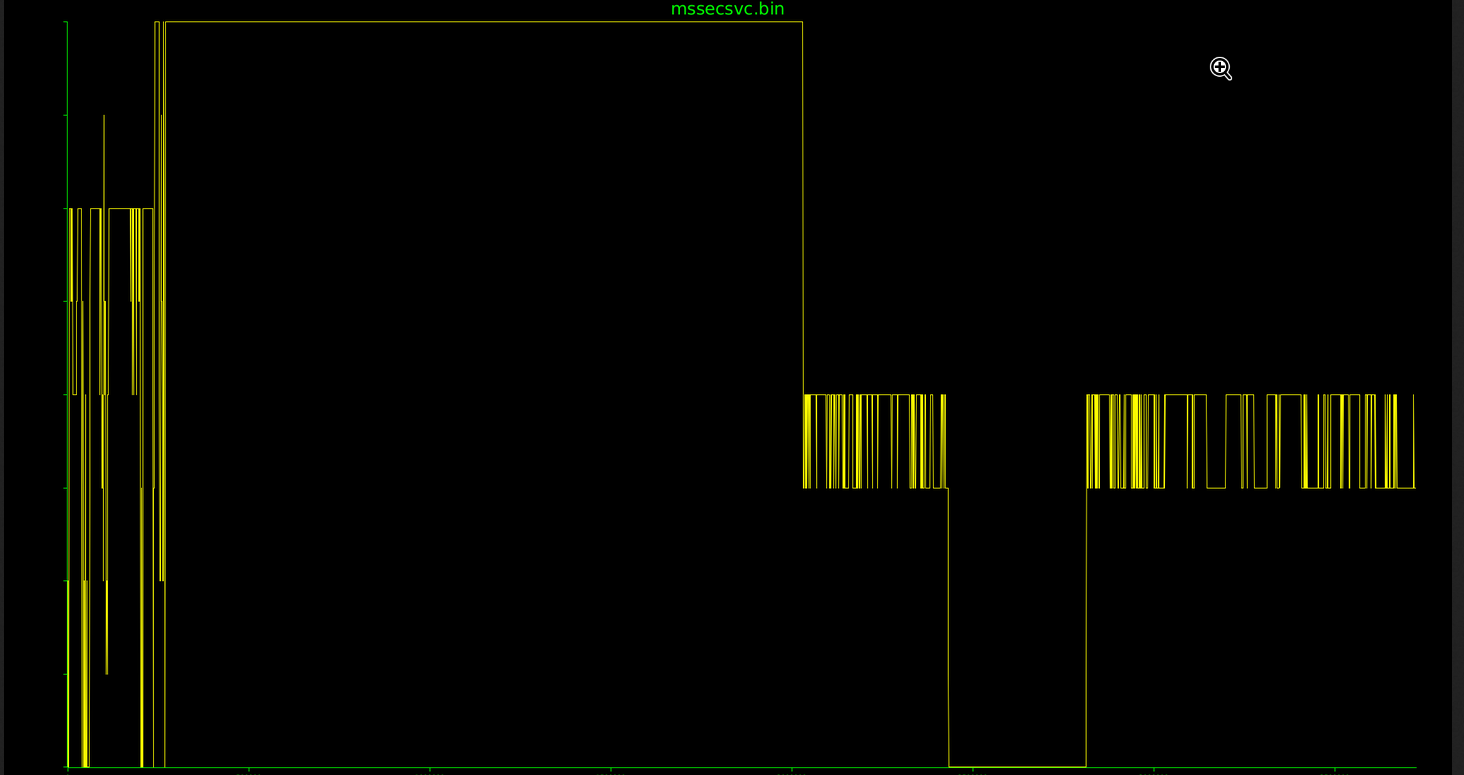 From left to right: normal code and data, then a long flat block at maximum entropy (compressed data embedded in the program), then a sudden drop around the middle of the file to “structured data” levels, a stretch of zeros, and structured data again until the end.
The flat block is expected: it’s a compressed archive that belongs to the next stages. What isn’t expected is for it to stop in the middle. Compressed data doesn’t turn into readable data halfway through. Looking at those bytes, they don’t belong to WannaCry at all. They are fragments of Windows file paths in NT device form, such as:
\Device\HarddiskVolume2\Windows\System32\DriverStore\ru-RU\netrass.inf_loc
\Device\HarddiskVolume2\Windows\System32\ru-RU\runonce.exe.mui
\Device\HarddiskVolume2\Windows\System32\config\systemprofile\AppData\Local\Avg\av16\temp\avg-49fb6b11-....tmp
These are paths from the machine the sample was taken from (it had AVG installed and Russian language files), not from the malware. They start around offset 0x1FC000 of the original file and continue to the end of the embedded worm.
The most likely explanation is that the file was recovered imperfectly, for example carved from a disk after some of its clusters had already been reused by other files, or rebuilt from memory. The .reloc section of the DLL being entirely zeros points the same way. In any case, it isn’t encryption: the replaced bytes have lower entropy and are readable text.
It also doesn’t say anything about who wrote the malware. The Russian paths describe the victim’s system, not the author.
This damage has consequences for the rest of the analysis. The code of both stages is intact, but the archive at the end of the chain is cut short, and the module that actually encrypts files is one of the casualties. I’ll point out where this matters.
Stage 2 — mssecsvc.exe, the Worm
The kill switch that doesn’t kill anything
WinMain is the first thing the worm runs, and it starts with the most famous URL in malware history:
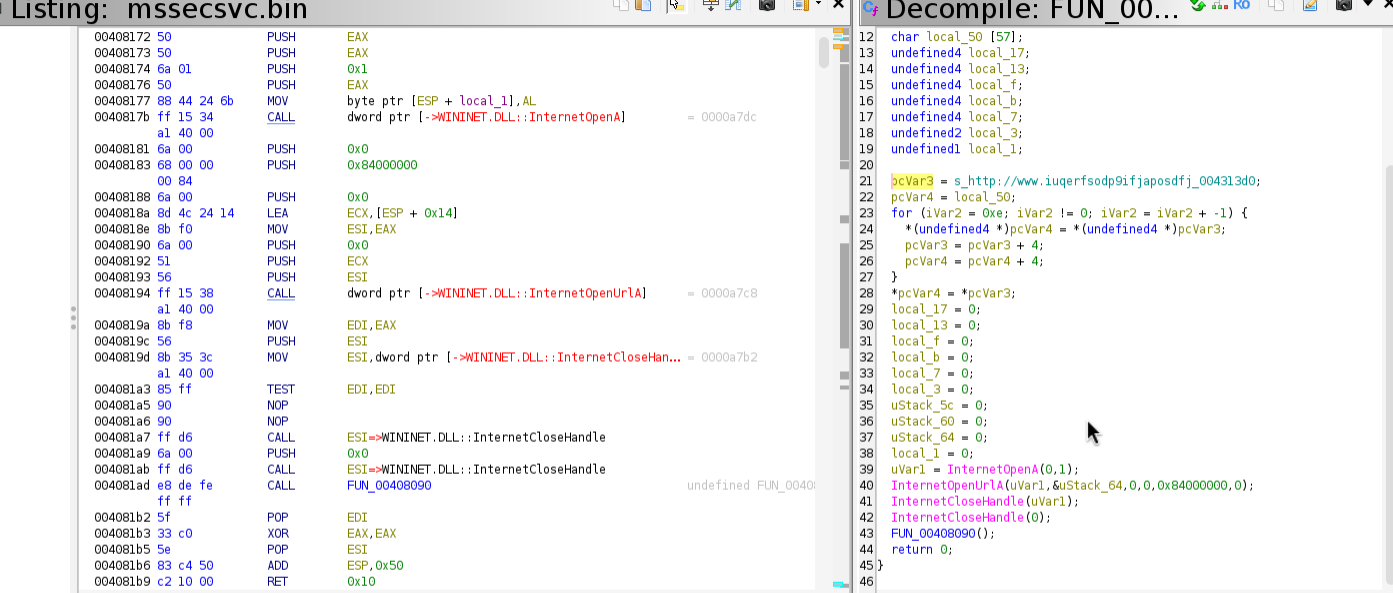 The URL is copied to a local buffer, then
InternetOpenA (access type 1, INTERNET_OPEN_TYPE_DIRECT, so no proxy) and InternetOpenUrlA with flags 0x84000000 (INTERNET_FLAG_RELOAD | INTERNET_FLAG_NO_CACHE_WRITE).
In the original WannaCry, if that request succeeded the program would close everything and quit. That’s how the outbreak was slowed down on 12 May 2017: a researcher noticed the unregistered domain in the code, registered it, and from that moment every new infection got an answer and stopped.
The decompiled code here has no if around the call that comes next. The listing shows why:
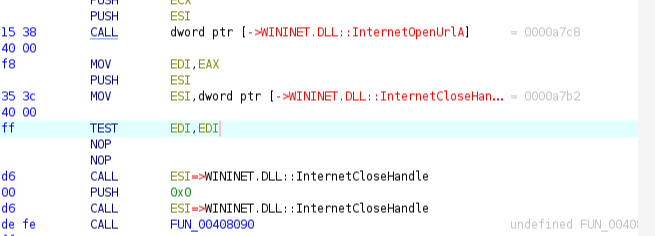 The result of
InternetOpenUrlA is moved to EDI and tested, but the jump that should follow is gone: two NOPs in its place.
| Offset | Original WannaCry | This sample |
|---|---|---|
0x4081A5 |
75 0E — JNZ → close handles and exit |
90 90 — NOP NOP |
The result of the request is computed and then ignored. Whether the domain answers or not, the worm carries on. Two things tell me this is a deliberate patch and not part of the damage: the corruption is far away in the second half of the file, while this is in the code section near the start, and it’s exactly the two bytes of a conditional jump, replaced by two valid instructions, with everything around them untouched. Variants with the kill switch removed this way started circulating shortly after the domain was registered. Since the code isn’t obfuscated or integrity-checked, it only takes a hex editor.
(Even in the original, the kill switch didn’t help everywhere. Because of INTERNET_OPEN_TYPE_DIRECT, machines that could only reach the internet through a proxy never got an answer and always kept going.)
Two modes: install and service
After the check, the worm looks at its command line:
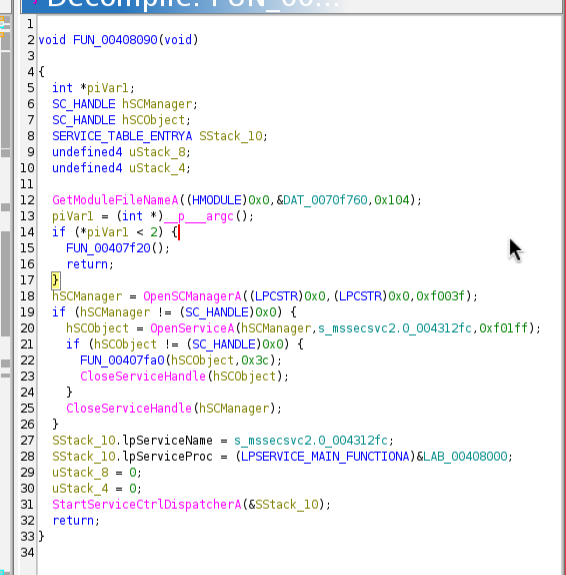 With fewer than two arguments it installs itself; otherwise it starts as a service.
When started with no arguments, as launcher.dll does, it:
- creates a service called
mssecsvc2.0, display name “Microsoft Security Center (2.0) Service”, that runs<its own path> -m securityand starts automatically; - drops and runs the next stage,
tasksche.exe(more on that below).
When the service starts, Windows passes -m security on the command line, so the argument count is 3 and the code takes the other branch. It sets the service’s failure actions to restart it after 60 seconds if it crashes, and hands control to ServiceMain:
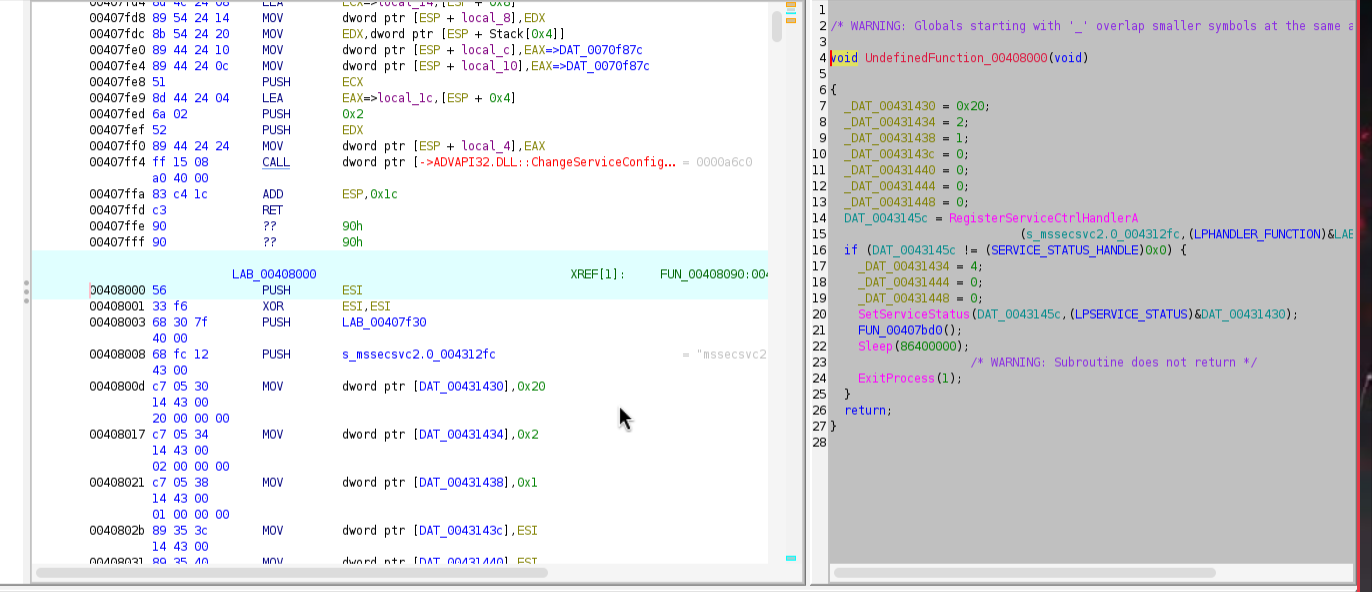 Register a control handler, report
SERVICE_RUNNING, run the worm, sleep for 86400000 ms (24 hours), exit.
The control handler is ordinary service boilerplate (stop, pause, continue). The real work happens in one call:
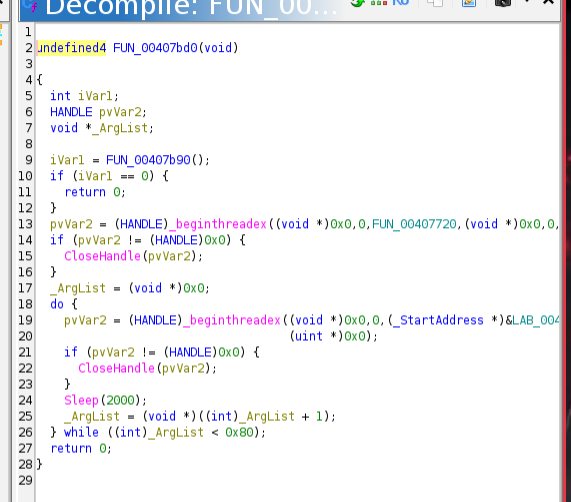 One thread for the local network, then 128 (
0x80) threads for the internet, one every 2 seconds.
Where my sample came from
Before starting the threads, the worm prepares what it will send to its victims. This is the part that explained the file I started from:
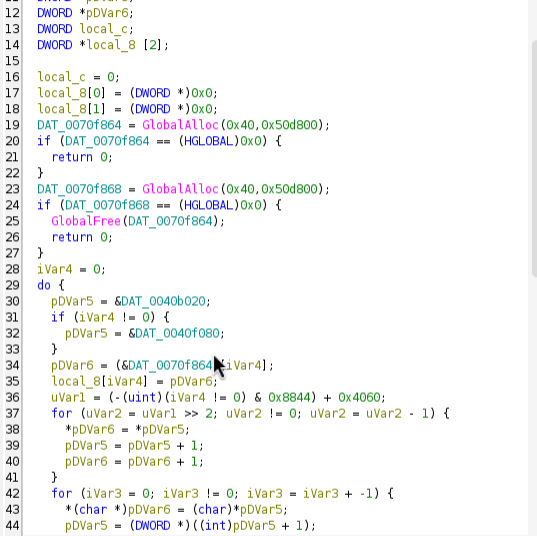 Two 5 MB buffers. One gets a blob from
0x40B020 (0x4060 bytes), the other a blob from 0x40F080 (0x4060 + 0x8844 bytes).
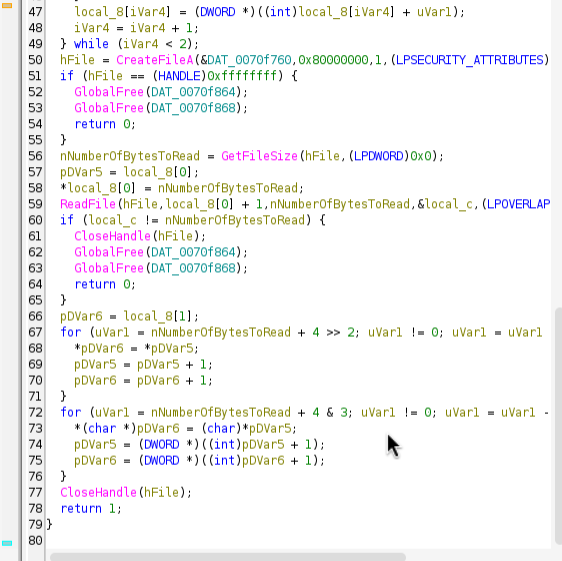 Then it opens its own executable (the path it got from
GetModuleFileNameA), and writes [file size][the whole file] after each blob.
Both blobs start with MZ:

I carved them out. The first is a 32-bit DLL and the second a 64-bit DLL, and both are called launcher.dll with a single export, PlayGame. The size of the second one is 0x4060 + 0x8844 = 0xC8A4, which is exactly the offset where resource W/101 started in my sample. Comparing the bytes:
$ cmp <(head -c $((0xc8a4)) e9c82c0f...a661.exe) launcher_x64.dll && echo identical
identical
So the structure is:
[ launcher.dll (x86 or x64) ][ 4-byte size ][ a copy of mssecsvc.exe ]
That’s exactly what PlayGame reads back: the size, then the executable. My sample is one of these packets, the 64-bit one, as built by an infected machine and delivered to the next. The worm sends it, the target loads the DLL, PlayGame drops mssecsvc.exe and runs it, and the cycle starts again.
Finding targets on the local network
The single local thread builds a list of addresses from the machine’s network configuration:
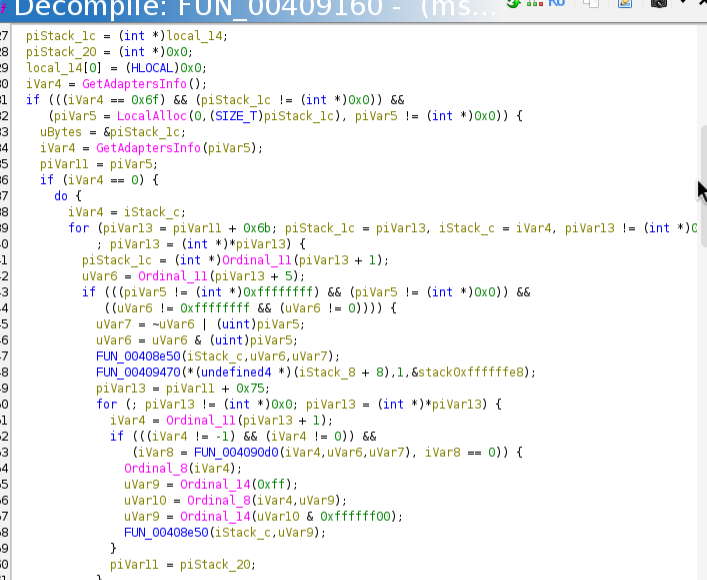
GetAdaptersInfo (called twice: the first call fails with 0x6F, ERROR_BUFFER_OVERFLOW, and returns the size it needs). For every IP address on every adapter it computes the network range from the IP and the subnet mask, and it also adds the /24 around each gateway.
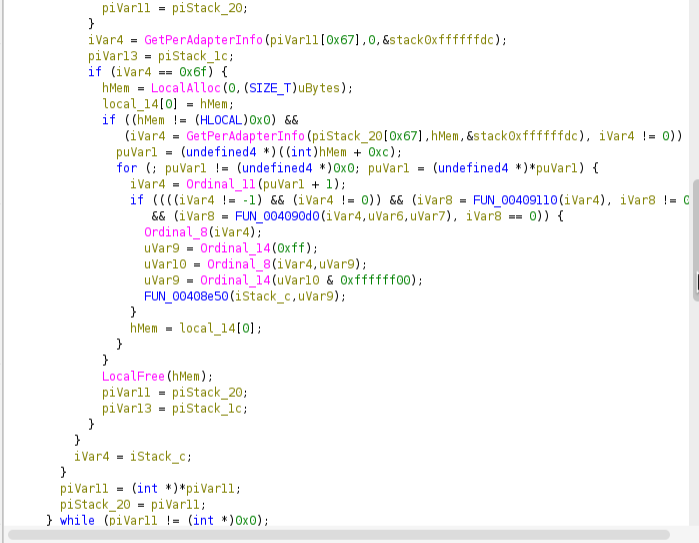
GetPerAdapterInfo adds the /24 of every configured DNS server.
This is smarter than it looks. In a company network, gateways and DNS servers often sit in different segments from the workstations (server rooms, domain controllers), so the worm reaches beyond its own subnet. The list is then sorted and duplicates are removed.
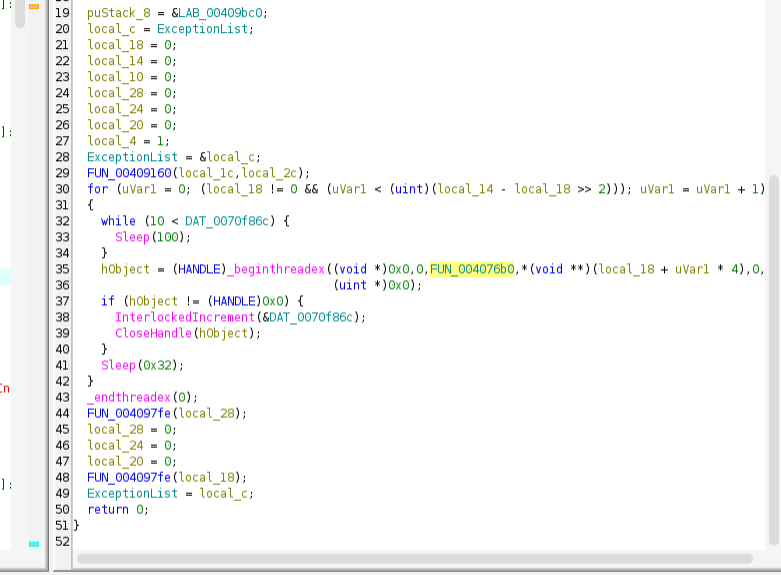 One thread per address, at most 10 at a time (an interlocked counter,
Sleep(100) while it’s full), 50 ms between addresses.
Each of those threads first checks whether port 445 (SMB) is open:
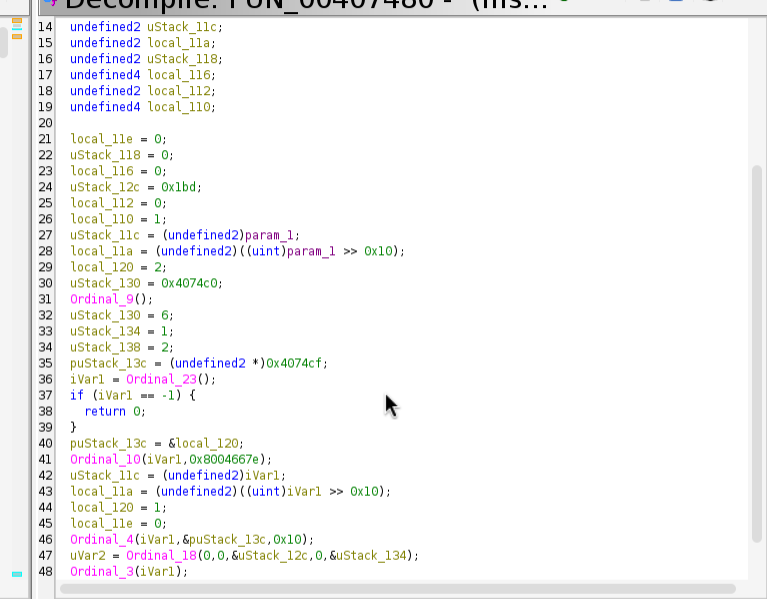 A non-blocking socket (
ioctlsocket with FIONBIO), connect, then select with a timeout of about a second.
A normal connect to an address that doesn’t answer can hang for 20 seconds or more. This way the worm gives up after about one second, which makes scanning much faster. If the port is open, the attack thread runs with a 10-minute limit; if it takes longer, it’s killed with TerminateThread.
All the socket functions in this binary are imported by number rather than by name, which is why Ghidra shows Ordinal_23, Ordinal_4 and so on. In WS2_32, 23 is socket, 4 connect, 19 send, 16 recv, 3 closesocket, 11 inet_addr, 9 htons, 10 ioctlsocket and 18 select.
Finding targets on the internet
The other 128 threads pick addresses at random:
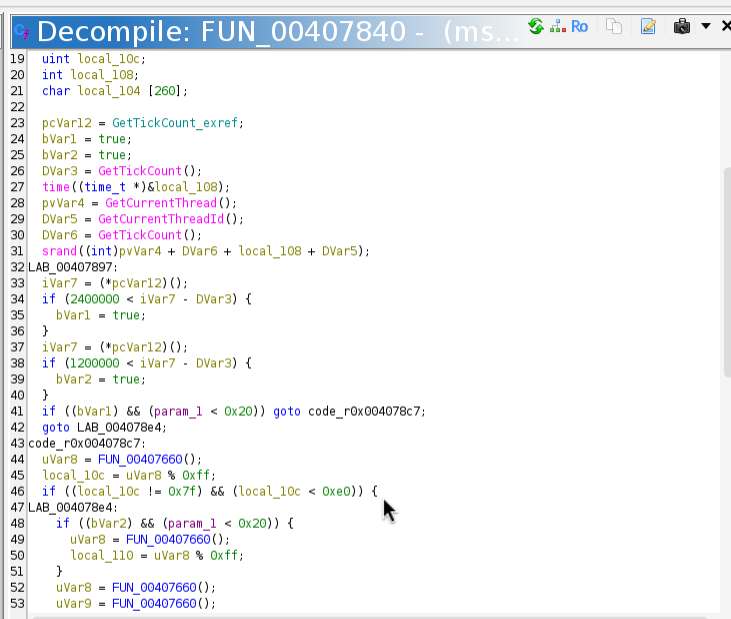 Each thread seeds
rand with its thread handle, the tick count, the time and its thread ID. The first octet is random but never 127 (loopback) or 224 and above (multicast and reserved).
The random numbers don’t come from rand alone:
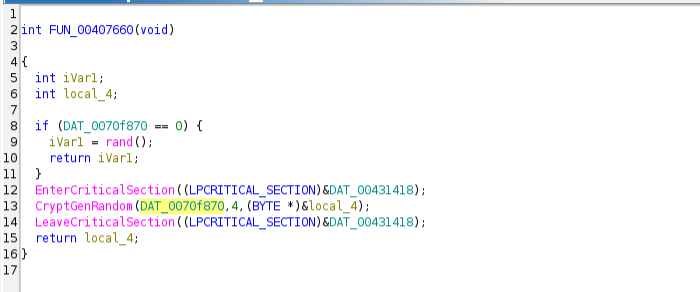
CryptGenRandom from the crypto context the worm opened at startup, protected by a critical section because 128 threads share it. Only if that fails does it fall back to rand().
That answers a question I had earlier: the worm calls CryptAcquireContextA with CRYPT_VERIFYCONTEXT at startup, and this is the only reason. It’s not encrypting anything; it just wants good random numbers.
A couple of details:
- The first octet only changes every 40 minutes and the second every 20 minutes, and only for the first 32 threads. So the worm stays in the same region of the internet for a while instead of jumping around.
- Private ranges (
10.x,172.16–31.x,192.168.x) are not excluded, so the “internet” threads also hit internal networks.
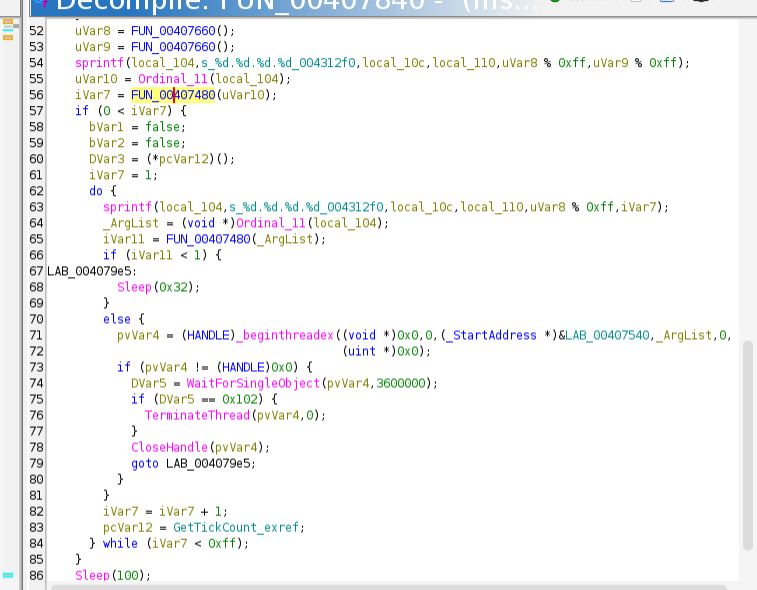 If a random address has port 445 open, the thread goes through the whole /24 (
.1 to .254) and attacks every host that answers, with a 1-hour limit per host.
Attacking a host
Every target, local or remote, goes through the same function:
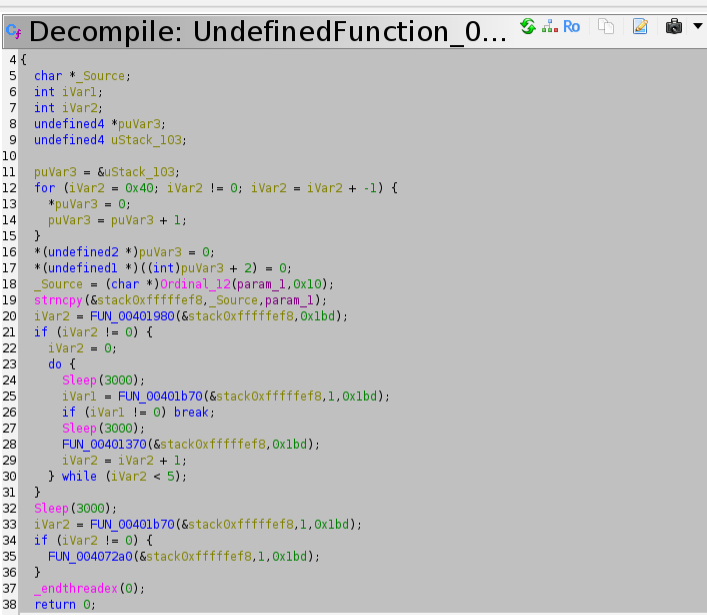 Check for MS17-010; if vulnerable, up to 5 rounds of “is the backdoor already there? if not, run the exploit”; then, if the backdoor answers, inject the payload.
if vulnerable to MS17-010:
    up to 5 times:
        wait 3 s
        if DoublePulsar answers → stop trying
        wait 3 s
        run EternalBlue
wait 3 s
if DoublePulsar answers → upload the launcher.dll packet
The two tools come from the April 2017 Shadow Brokers leak:
- EternalBlue exploits a bug in the SMBv1 driver of Windows (patched by Microsoft in bulletin MS17-010). When the server converts a list of “extended attributes” from an old format to a new one, it calculates the size of the destination buffer wrongly, allocates too little memory and copies too much into it. With careful preparation of the kernel’s memory, that overflow lets the attacker run code in the kernel of the remote machine, without credentials.
- DoublePulsar is what that kernel code installs: a backdoor that lives only in memory and hides inside normal SMB traffic. It hooks a rarely used SMB command and answers a special “ping”. Once it’s there, it can receive a DLL in chunks and load it into a user-mode process. That’s how
launcher.dllends up running on the victim andPlayGamegets called.
Each step is easy to recognise in the code.
The vulnerability check sends four SMB packets that are stored ready-made in the data section: Negotiate, an anonymous Session Setup, a connection to the IPC$ share, and a transaction on a named pipe (PeekNamedPipe). Then it looks at the status code in the answer:
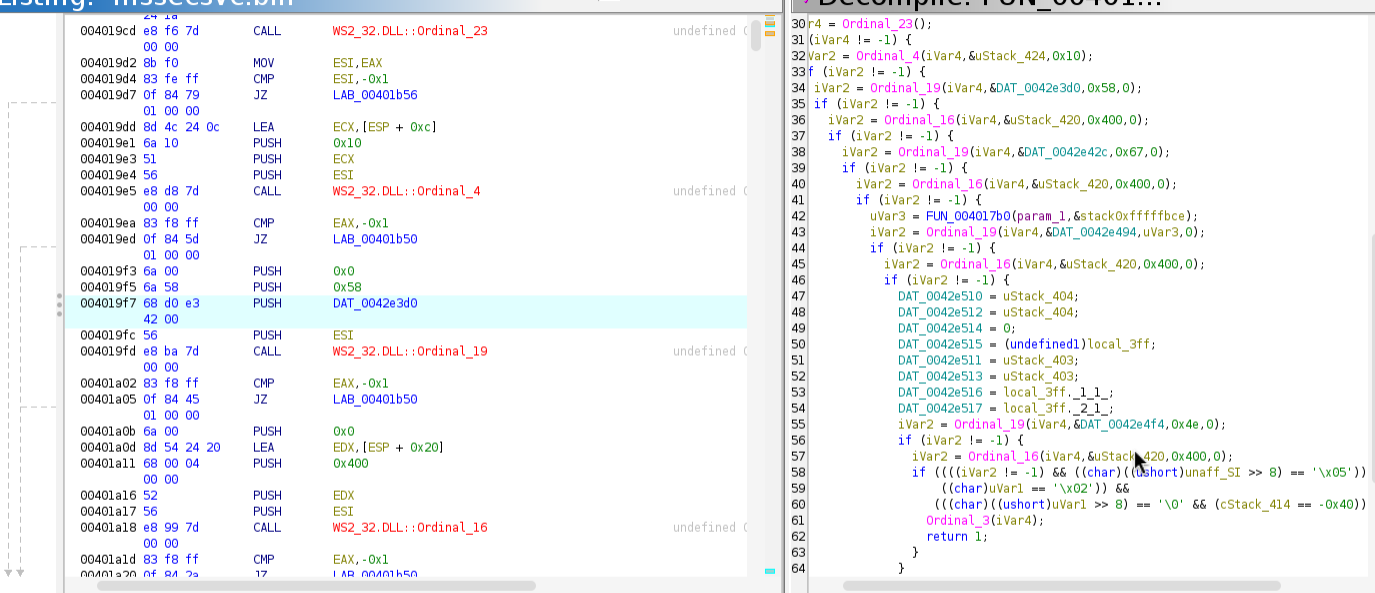 The bytes
05 02 00 C0 are the status 0xC0000205 (STATUS_INSUFF_SERVER_RESOURCES). An unpatched server answers this request with that error; a patched one doesn’t.
The packets are pre-recorded, which is visible both in the list of old SMB dialects stored in the binary and in a few placeholders that get replaced with the real values the server sends back:
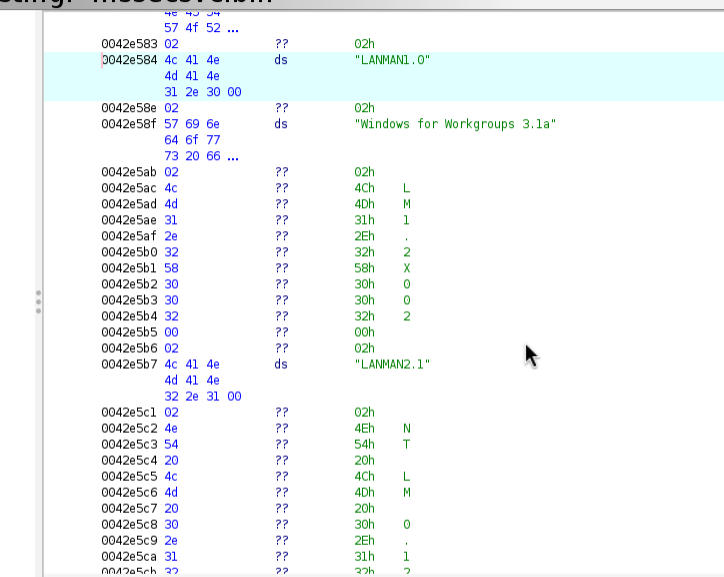 The dialect list of the Negotiate packet:
LANMAN1.0, Windows for Workgroups 3.1a, LM1.2X002, LANMAN2.1, NT LM 0.12.
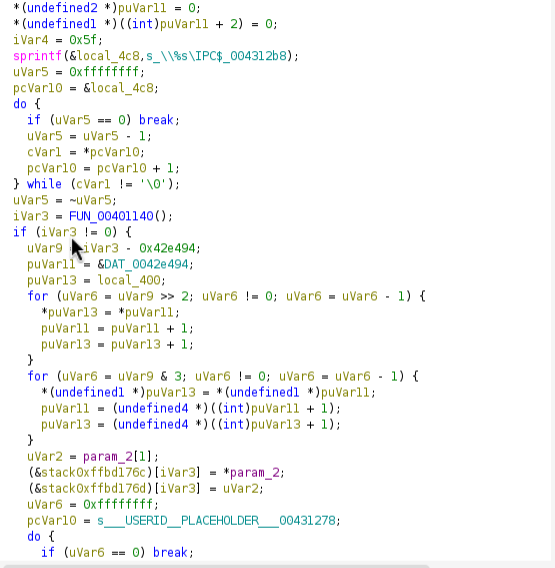
\\%s\IPC$ and __USERID__PLACEHOLDER__. Before sending the next packet, the worm patches in the user ID and tree ID from the server’s previous answer.
The backdoor check sends a Trans2 SESSION_SETUP packet, which is the DoublePulsar ping, and looks at the Multiplex ID field of the answer:
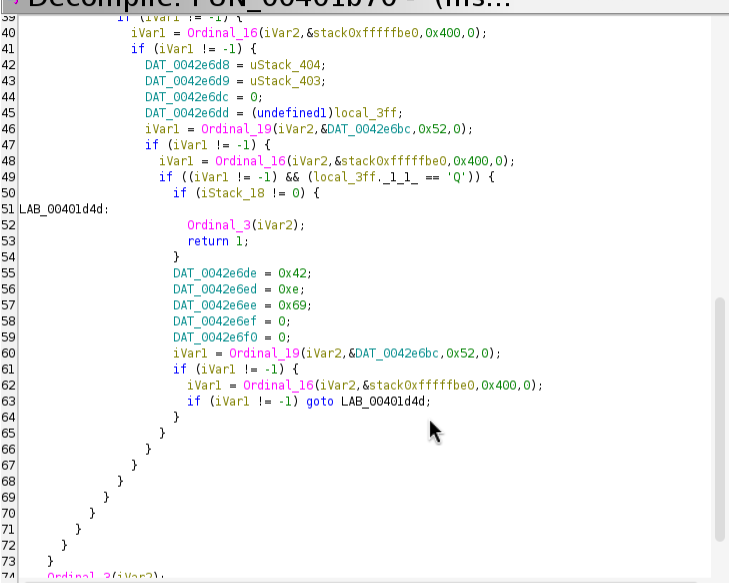 If the Multiplex ID is
0x51 ('Q'), the backdoor is installed.
This means the worm doesn’t fire EternalBlue at a machine that already has the backdoor, which avoids crashing it. It also means that a machine that is already patched but still has DoublePulsar from an earlier compromise will be infected anyway, because the last step only checks for the backdoor.
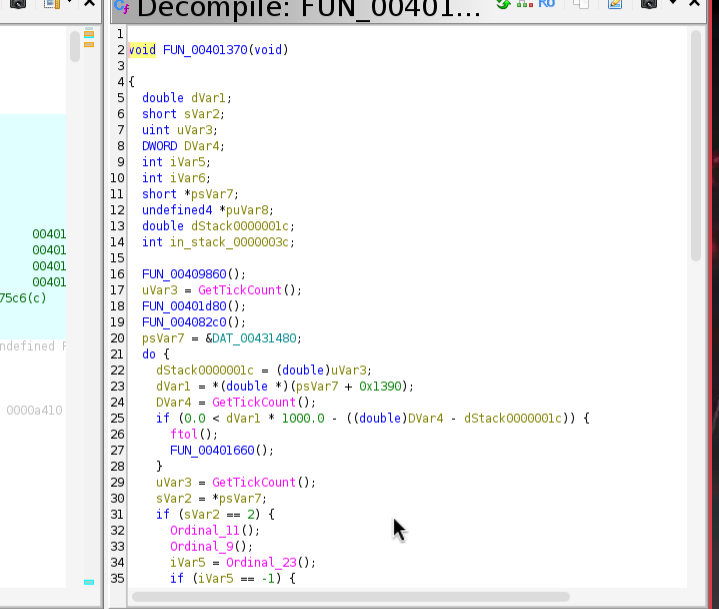
The exploit itself is the long function at 0x401370: many sockets, timing with GetTickCount, large blocks of prepared data. I identified it but didn’t take it apart instruction by instruction.
The injection pings the backdoor again, derives a key from its answer, and uploads the payload:
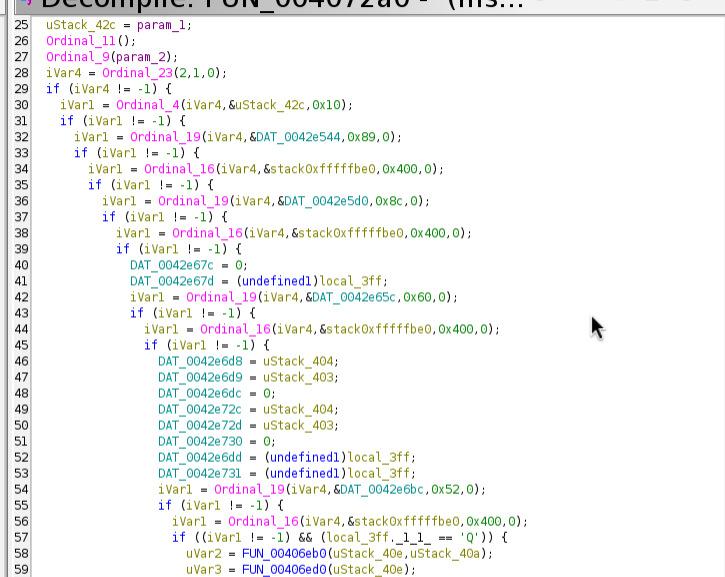 Same ping, same
'Q' check, then the key is computed from the answer.
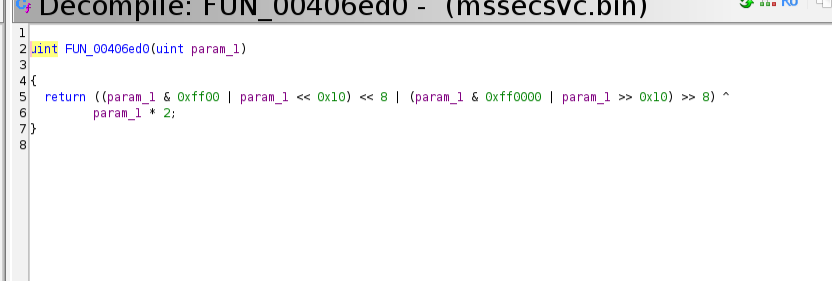 A 32-bit value from the answer is byte-swapped and XORed with twice its original value. The result is the XOR key DoublePulsar expects for the uploaded data.
Dropping the ransomware
The last thing the installer branch does is write and start the next stage:
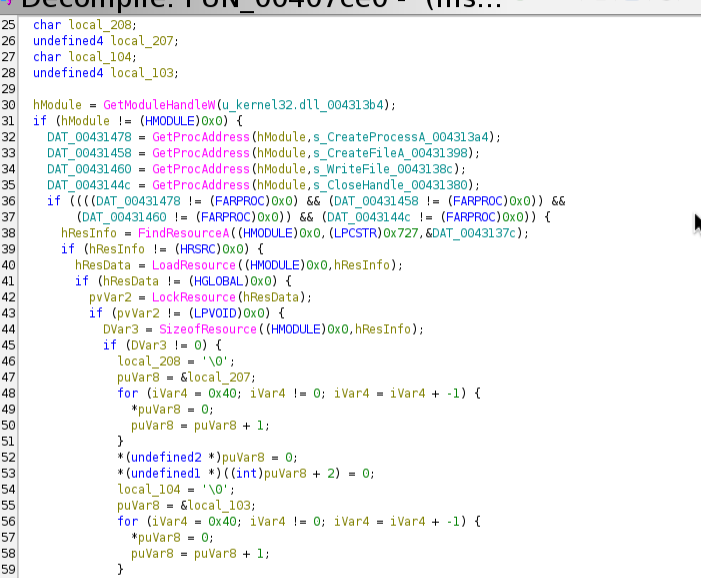
CreateProcessA, CreateFileA, WriteFile and CloseHandle are looked up with GetProcAddress instead of being imported, so they don’t appear in the import table. The resource is FindResourceA(NULL, 0x727, "R"), i.e. type R, ID 1831.
It builds C:\WINDOWS\tasksche.exe, moves any existing copy to C:\WINDOWS\qeriuwjhrf, and writes the whole resource. This time there’s no size field in front: the resource starts directly with MZ.
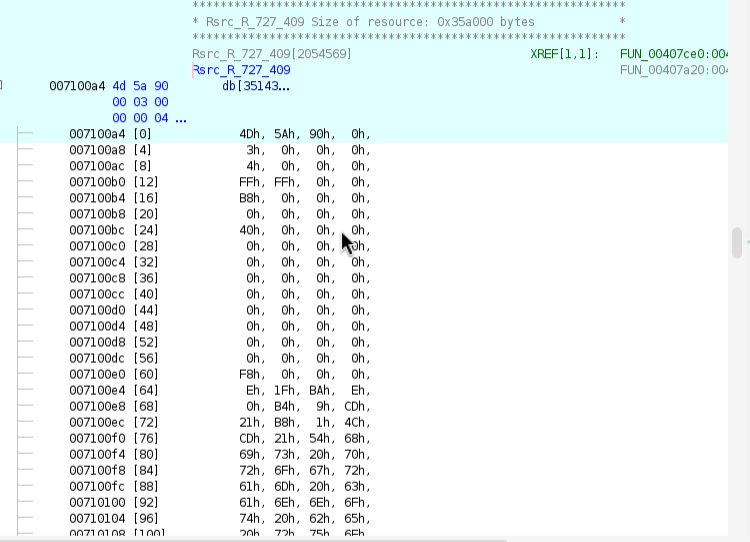
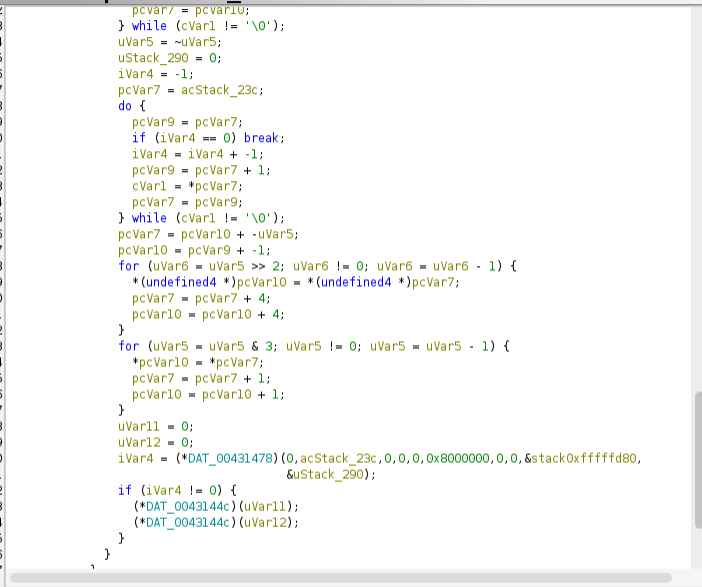 The path gets
" /i" appended and is started with CREATE_NO_WINDOW.
$ dd if=mssecsvc.bin of=tasksche.bin bs=1 skip=$((0x320a4)) count=$((0x35a000))
$ file tasksche.bin
PE32 executable (GUI) Intel 80386, for MS Windows, 4 sections
Its compile timestamp says 20 November 2010, two minutes after the one in mssecsvc.exe. Neither is believable; the DLL’s May 2017 date is the realistic one.
Stage 3 — tasksche.exe, the Ransomware Installer
The main flow
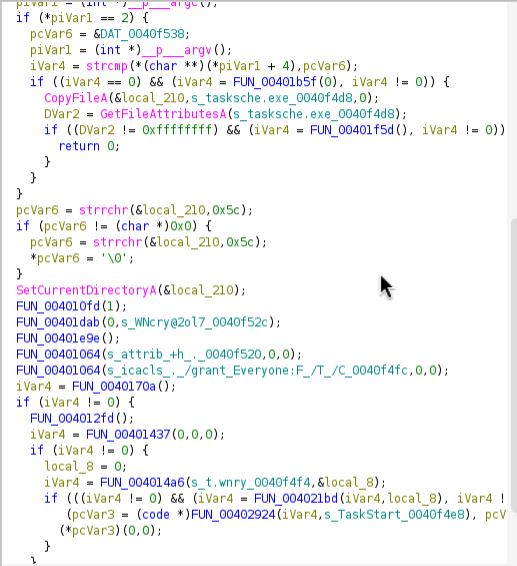
In order, WinMain:
- generates a victim ID from the computer name;
- if started with
/i, creates a folder named after that ID (inC:\ProgramData,C:\Intelor%TEMP%, trying them in that order, with the drive taken from the Windows folder), copies itself there astasksche.exeand starts that copy, as a service if it can (cmd.exe /c "<path>"); - saves its working folder in the registry;
- extracts an embedded password-protected archive;
- writes one of three Bitcoin addresses into the configuration;
- runs
attrib +h .(hide the folder) andicacls . /grant Everyone:F /T /C /Q(give everyone full control of it), both hidden; - imports an RSA key, decrypts
t.wnry, loads the result in memory as a DLL and calls its exportTaskStart.
The victim ID
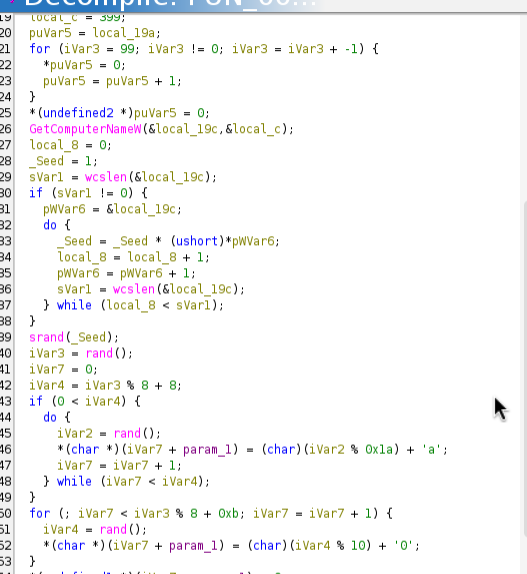 The characters of the computer name are multiplied together to make the seed for
srand. Then 8–15 lowercase letters and 3–10 digits.
Because the seed comes from the computer name, the ID looks random but is the same every time on the same machine.
Registry
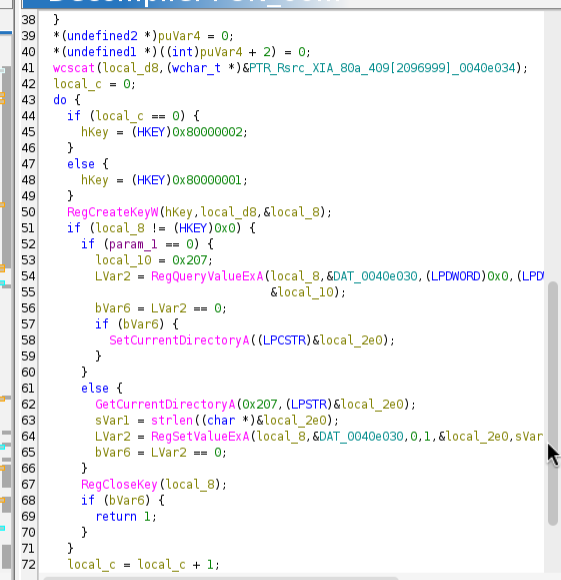
HKLM\Software\WanaCrypt0r (or HKCU if that fails), value wd = the working folder. With a different parameter, the same function reads it back and moves into that folder.
The archive
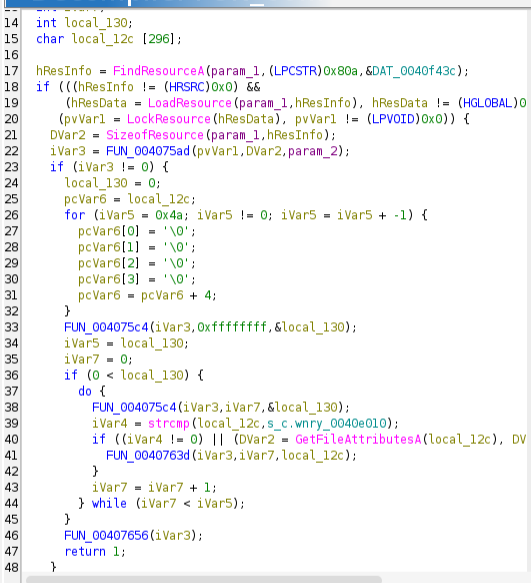
FindResourceA(hModule, 0x80A, "XIA"), so type XIA, ID 2058. The archive is opened in memory with the password passed by WinMain, and every entry is written out. c.wnry is skipped if it already exists.
The password is right there in WinMain: WNcry@2ol7. It’s written to look like “2017”, but it’s “2”, lowercase “o”, lowercase “l”, “7”.
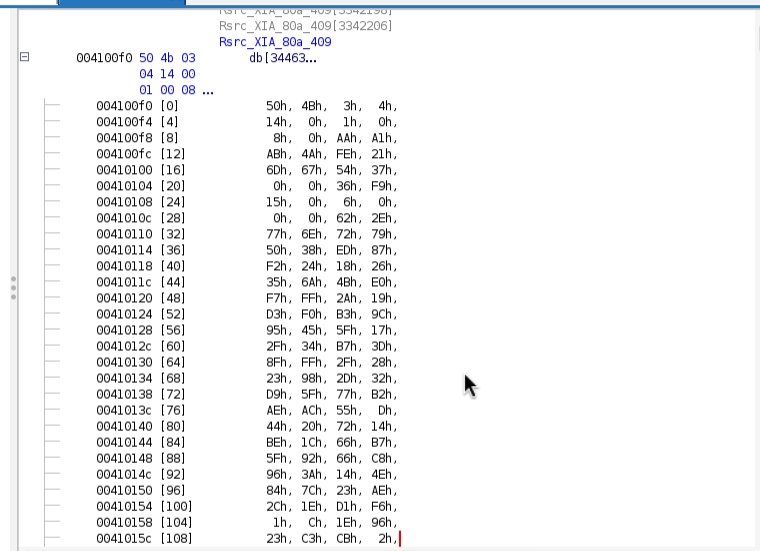
50 4B 03 04 (PK), flag 0x0001 (encrypted), method 8 (deflate). The first file is b.wnry.
$ dd if=tasksche.bin of=xia_2058.zip bs=1 skip=$((0x100f0)) count=$((0x349635))
$ 7z x -pWNcry@2ol7 xia_2058.zip
ERROR: Data Error in encrypted file. Wrong password? : s.wnry
The password is correct. The error is the damage catching up with us. The end of the archive, including the index that ZIP files keep at the very end, is gone. This is what could be recovered:
| File | Size | State | What it is |
|---|---|---|---|
b.wnry |
1,440,054 | intact | the desktop wallpaper |
c.wnry |
780 | intact | configuration: Tor C2 addresses, Tor download URL |
r.wnry |
864 | intact | FAQ text for the victim |
msg/m_*.wnry |
28 files | intact | the ransom window text in 28 languages (RTF) |
s.wnry |
1,501,522 | cut short | a ZIP with the Tor client |
t.wnry |
— | missing | the encrypted module that encrypts files |
u.wnry |
— | missing | @WanaDecryptor@.exe, the ransom window |
taskdl.exe, taskse.exe |
— | missing | helper programs |
c.wnry — the C2
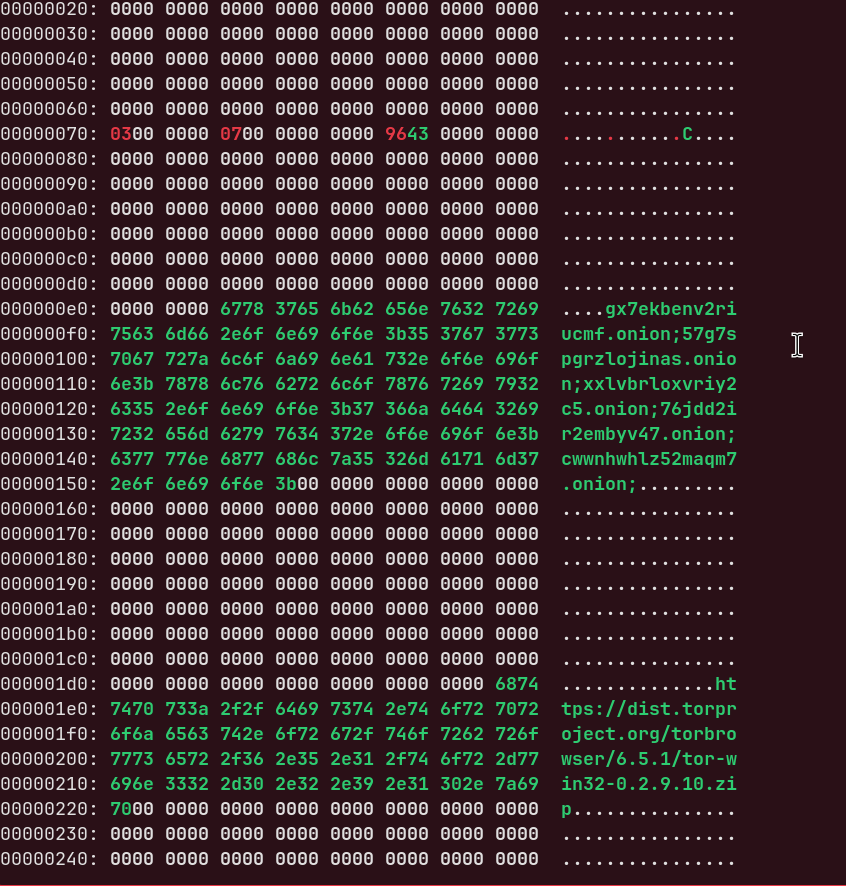 Five Tor hidden services at offset
0xE4, the Tor download URL at 0x1DE, and an empty slot at 0xB2.
The five .onion addresses are how the ransom window talks to the attackers: to check payments and to send messages. They are only reachable through Tor, so they can’t be blocked or taken over through DNS like the kill switch domain. The URL points to the official Tor Project site; it’s there in case the bundled Tor client is missing. It’s a legitimate site being used, not a malicious one.
The empty slot at 0xB2 is where the Bitcoin address goes. It’s empty in the archive because it’s filled in on the victim’s machine:
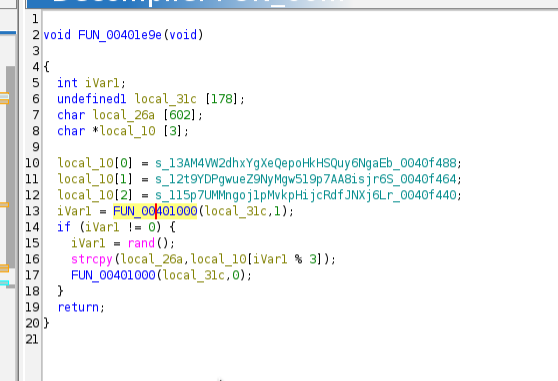 Three hard-coded addresses. One is picked with
rand() % 3, copied into the 780-byte configuration at offset 178 (0xB2), and the file is written back.
The other files
b.wnry is a plain 800×600 bitmap. Converted to PNG:
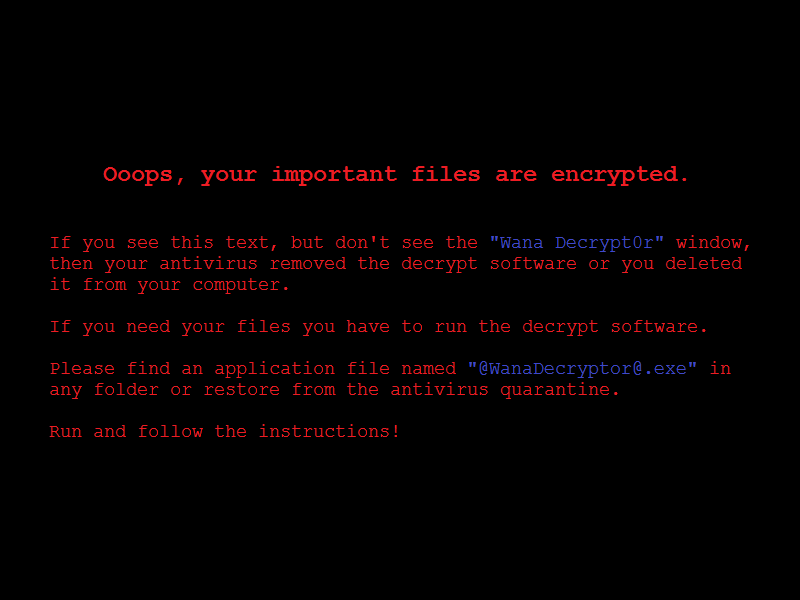 The wallpaper. It’s the fallback: if the antivirus removes the ransom window, the instructions are still on the desktop.
r.wnry is a short FAQ, with %s placeholders for the amount, the Bitcoin address and the name of the decryptor:
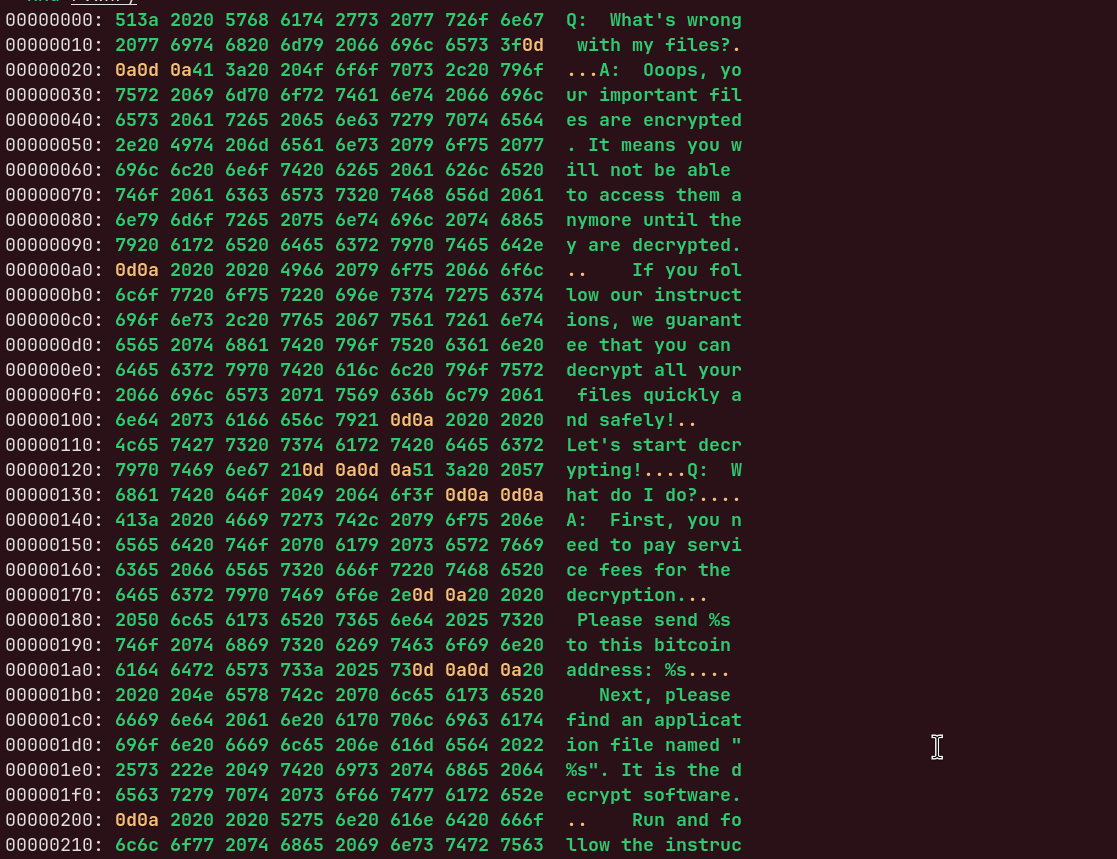
The msg files are the text of the ransom window. The English one, converted from RTF:
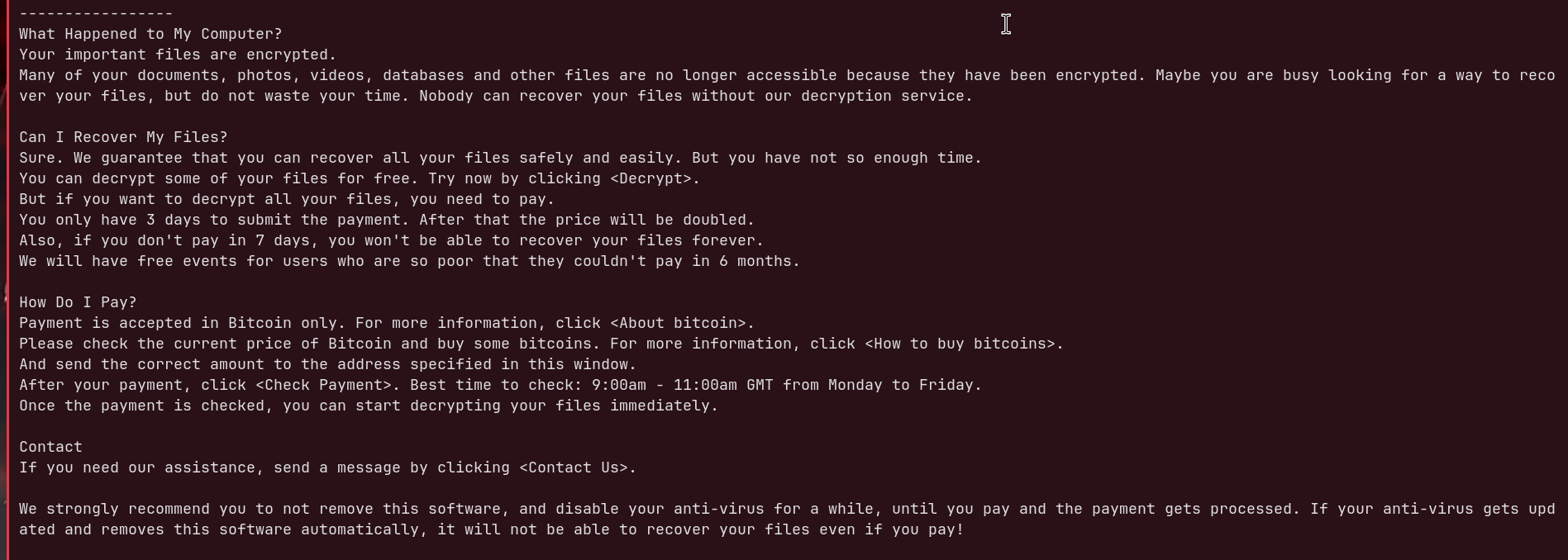 3 days before the price doubles, 7 days before the files are “lost forever”, Bitcoin only, a “Check Payment” button with a suggested time of 9–11 am GMT Monday to Friday, and a request to disable the antivirus.
There’s no amount in any of these files; it was filled in at runtime by the ransom window, which is one of the missing files.
s.wnry is the Tor client, or what’s left of it:
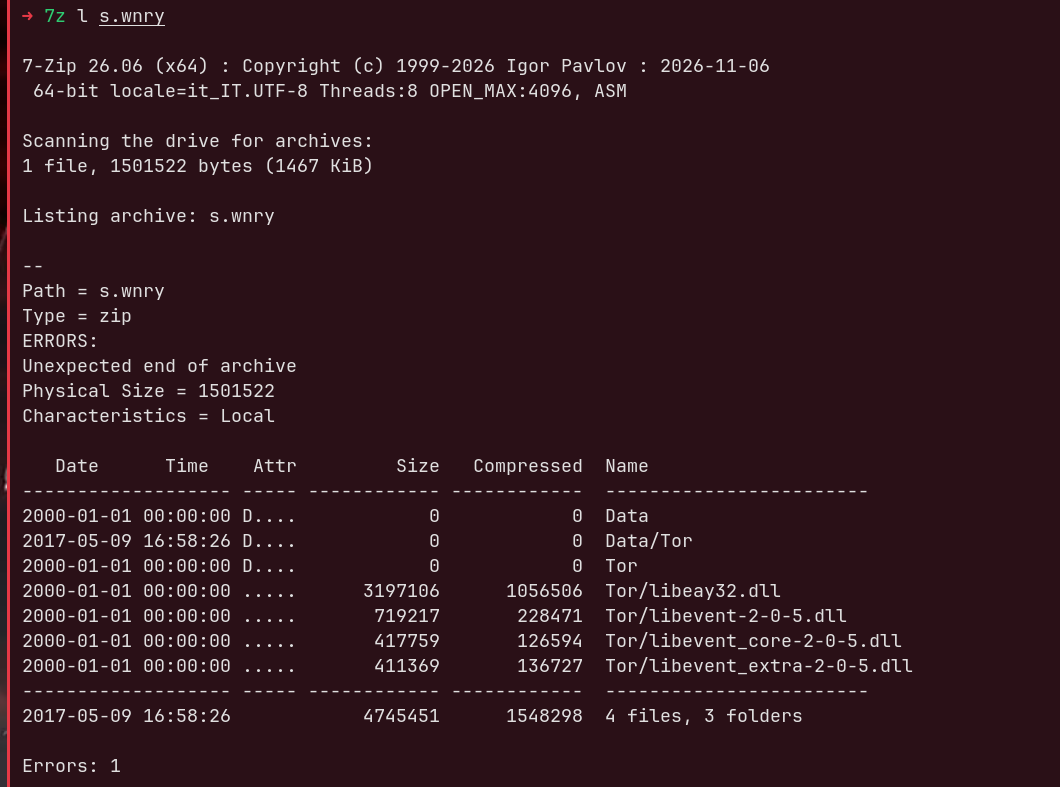 The folders and the support DLLs are there;
tor.exe itself is past the point where the archive is cut. The folder date is 9 May 2017.
How the Encryption Works
This is the part that’s easiest to misunderstand, so I’ll split it into what I could see in this sample and what comes from public reporting on the missing module.
What’s in tasksche.exe
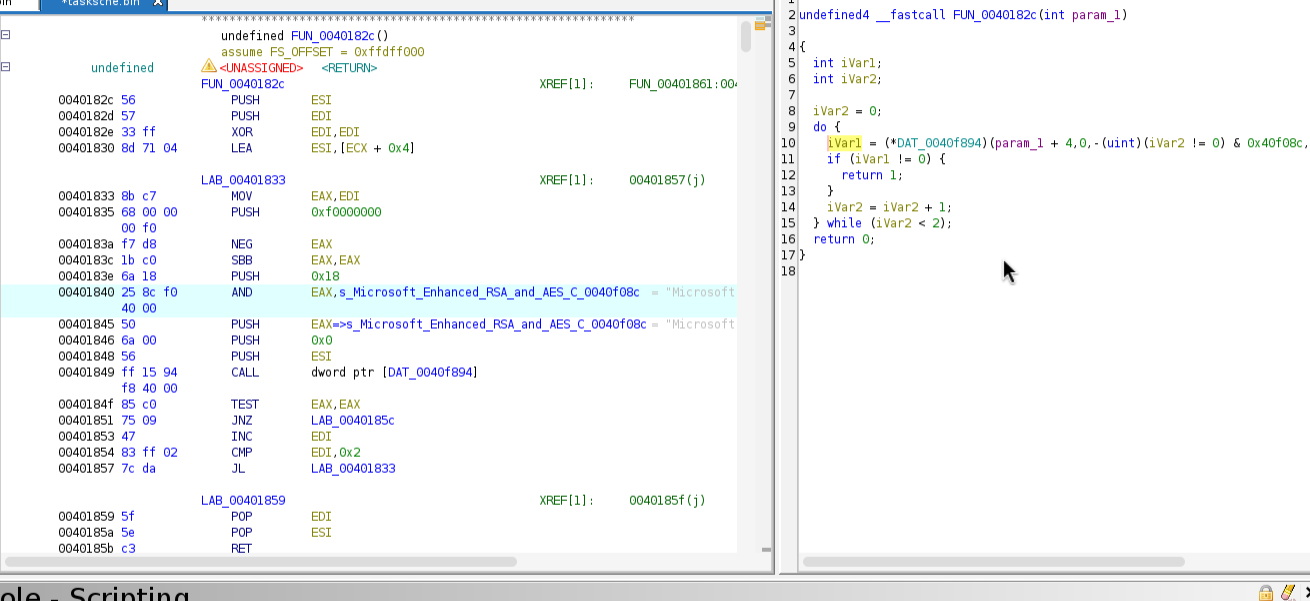 “Microsoft Enhanced RSA and AES Cryptographic Provider”, type
0x18 (PROV_RSA_AES), temporary context.
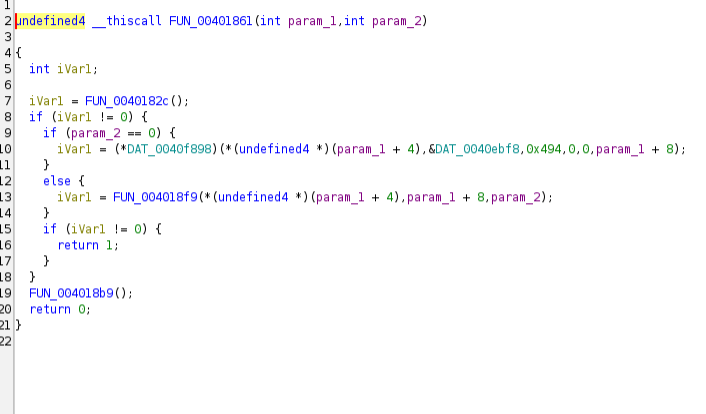
CryptImportKey on 0x494 (1,172) bytes at 0x40EBF8.
The bytes at that address are a Windows key blob:
07 02 00 00   PRIVATEKEYBLOB, version 2
00 A4 00 00   CALG_RSA_KEYX
52 53 41 32   "RSA2" — a private key
00 08 00 00   2048 bits
01 00 01 00   public exponent 65537
...           modulus, primes and the rest
A complete 2048-bit RSA private key, in plain sight. What it’s used for:
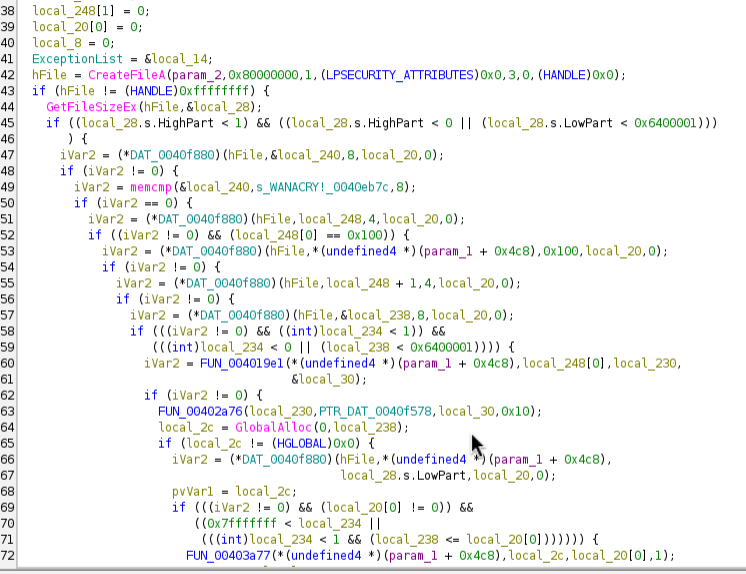
t.wnry must start with WANACRY!. Next comes a length (0x100), then 256 bytes that are decrypted with the embedded RSA key and give an AES-128 key. A size check follows (less than 100 MB), and the rest is decrypted with AES.
WANACRY! is a magic value, eight bytes that mark the format, like MZ for executables or PK for ZIP files. The decrypted result is a DLL that gets loaded straight from memory, without ever being written to disk, and its TaskStart export is called.
So that private key doesn’t protect anything from the victim. It works like a padlock with the key hanging next to it. Its only job is to make sure the module that does the encryption sits on disk in encrypted form, where an antivirus scanning files won’t recognise it.
What TaskStart does (public reporting)
t.wnry is one of the files lost to the damage, so this part comes from published analyses of intact samples, not from this one.
There are three layers of keys, and the simplest way I found to think about them is padlocks. With RSA, the public key works like an open padlock: anyone can close it, but only the owner of the matching private key can open it again.
- The DLL contains the attacker’s public key. The matching private key never leaves the attacker.
- On the victim’s machine, a new RSA key pair is generated for that victim. The victim’s public key is saved as
00000000.pky. The victim’s private key is locked with the attacker’s public key and saved as00000000.eky. The unlocked copy only exists in memory. - For every file, a random AES-128 key is generated, the file is encrypted with it, the AES key is locked with the victim’s public key and stored in the file’s header, and the result is saved as
<name>.WNCRY. The header starts with the sameWANACRY!magic. - A handful of files are encrypted with a separate “demo” key whose private half is included, so the ransom window can decrypt them for free as proof.
To get the files back, the ransom window sends the .eky file to the attackers through Tor. They open it with their private key and send back the victim’s private key, which opens the AES keys, which open the files. The attacker’s key never touches a single document: it only ever opens one small file, and that’s enough because that file holds the key to everything else.
This is why paying is the only way out when the scheme is used correctly. There are only two well-known exceptions. On some Windows versions, the victim’s private key could still be found in memory if the machine hadn’t been rebooted (that’s what the WanaKiwi tool did). And the way original files were deleted sometimes left them recoverable with forensic tools.
The ransom window (u.wnry, @WanaDecryptor@.exe) is also missing here. From public reporting, it shows the timers and the Bitcoin address, runs Tor to reach the .onion addresses, does the demo decryption, and is restarted with high privileges to delete shadow copies and disable Windows recovery (vssadmin, wmic shadowcopy, bcdedit, wbadmin). None of those commands are in the files I could recover.
Following the Money
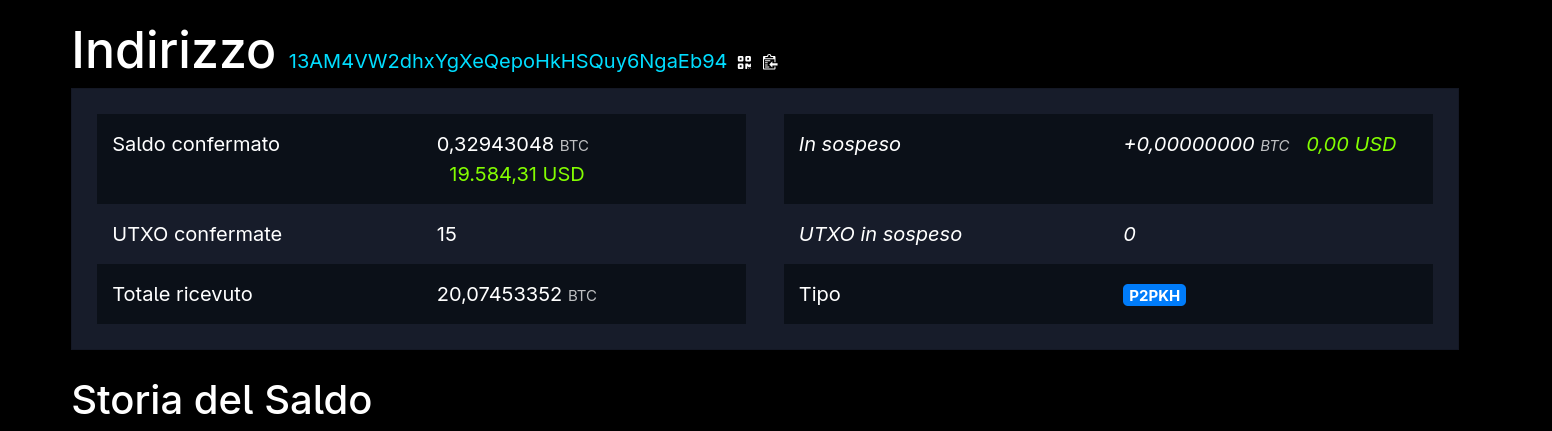
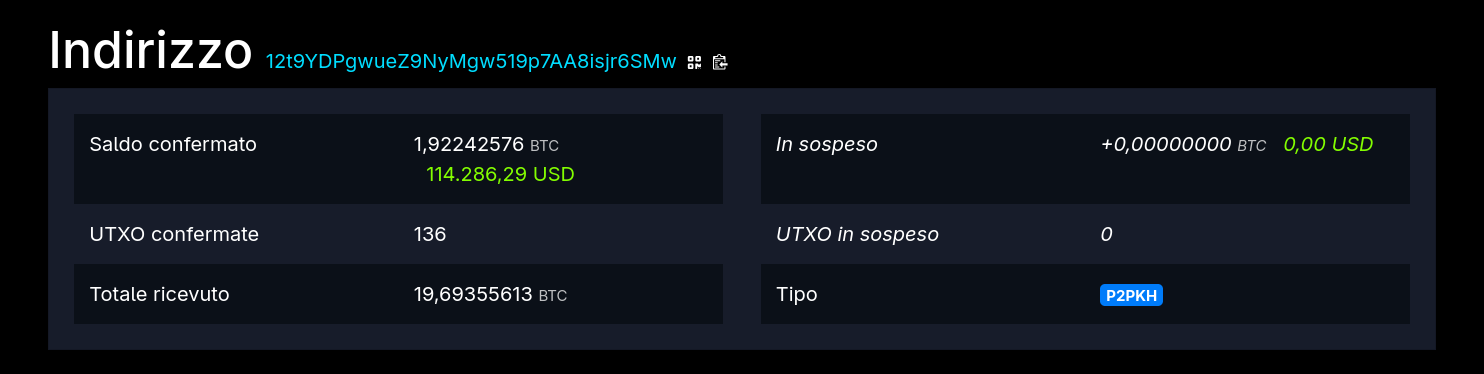
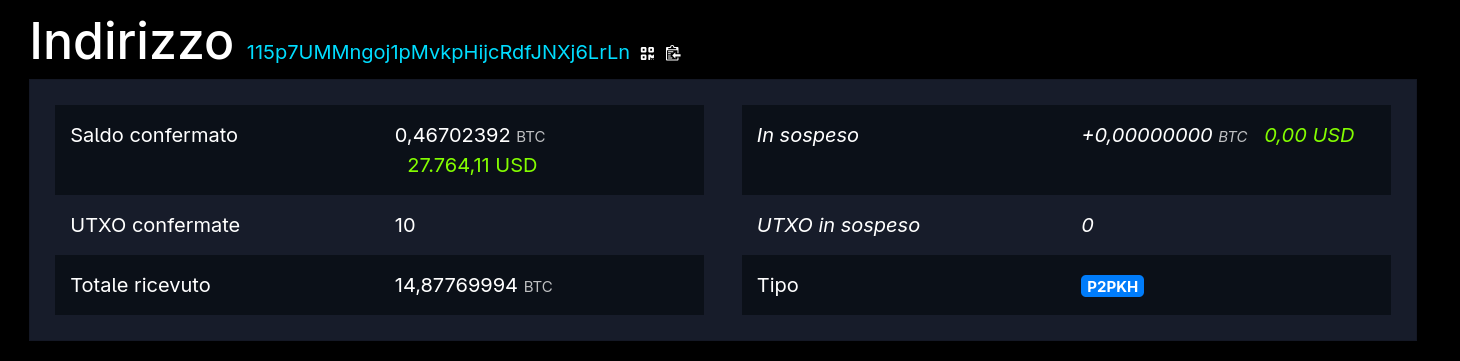
Bitcoin transactions are public, so the three addresses can be looked up on any blockchain explorer. I checked them on 28 November 2026:
| Address | Received | Balance today | Moved out |
|---|---|---|---|
13AM4VW2dhxYgXeQepoHkHSQuy6NgaEb94 |
20.0745 BTC | 0.3294 BTC | 19.7451 BTC |
12t9YDPgwueZ9NyMgw519p7AA8isjr6SMw |
19.6936 BTC | 1.9224 BTC | 17.7712 BTC |
115p7UMMngoj1pMvkpHijcRdfJNXj6LrLn |
14.8777 BTC | 0.4670 BTC | 14.4107 BTC |
| Total | 54.65 BTC | 2.72 BTC | 51.93 BTC |
The balance history of all three has the same shape: a quick climb to between 14 and 20 BTC, then a sudden drop to zero at the same moment on all three addresses. That matches the known cash-out of early August 2017. What’s left today comes from small payments made afterwards, which were never spent.
So what the attackers actually took is the money that left the addresses: received minus what’s still there, about 51.9 BTC. With Bitcoin at around $2,700 in August 2017, that was roughly $140,000. The explorer shows much bigger dollar figures, but those use today’s price, and according to public reporting the coins were converted to Monero back then. For a campaign that hit more than 200,000 computers and caused damage estimated in the hundreds of millions, it’s a remarkably small amount: as a way of making money, WannaCry failed.
All victims shared the same three addresses, so there was no way to tell from the blockchain who had paid. Together with the “check payment between 9 and 11 GMT” line in the ransom text, that suggests payments were matched by hand, if at all.
Architecture Overview
launcher.dll (x64, this sample)         ← delivered by DoublePulsar, PlayGame() called
 └─ resource W/101: [size][mssecsvc.exe] → C:\WINDOWS\mssecsvc.exe, started hidden
     └─ mssecsvc.exe (x86)
          ├─ kill switch request ── result ignored (JNZ patched to NOP NOP)
          ├─ no args → install
          │    ├─ service "mssecsvc2.0"  (-m security, auto start, restart on failure)
          │    └─ resource R/1831 → C:\WINDOWS\tasksche.exe /i
          └─ as a service → worm
               ├─ build packets: launcher.dll x86/x64 + [size][mssecsvc.exe]
               ├─ LAN: own subnets + /24 of gateways and DNS, 10 threads
               ├─ internet: 128 threads, random IPs, whole /24 on a hit
               └─ per host (TCP/445): MS17-010 check → EternalBlue → DoublePulsar upload
tasksche.exe (x86)
 ├─ /i → hidden folder named after the victim ID, copy + start
 ├─ HKLM|HKCU\Software\WanaCrypt0r  wd = folder
 ├─ resource XIA/2058 → ZIP, password WNcry@2ol7  (archive cut short by the damage)
 │    b.wnry wallpaper · c.wnry Tor C2 · r.wnry FAQ · msg/*.wnry · s.wnry Tor (partial)
 │    t.wnry · u.wnry · taskdl.exe · taskse.exe  → missing
 ├─ one of 3 BTC addresses → c.wnry
 ├─ attrib +h . · icacls . /grant Everyone:F /T /C /Q
 └─ t.wnry: RSA (embedded key) → AES key → DLL in memory → TaskStart()  [module missing]
IOCs
| Type | Value |
|---|---|
| SHA256 (sample, x64 launcher packet) | e9c82c0f40b82eb9e7fffa7600628fa5dbe6a387829ec13342bb8d75f34ea661 |
| MD5 (sample) | 430845d1c3483f638d2d141f27ead1b6 |
SHA256 launcher.dll x64 (first 0xC8A4 bytes) |
2f9d5e64acffc7513aec4f9d5adb5eafe5fa112eb83997ee05efaba9b12ece70 |
| SHA256 launcher.dll x86 (from mssecsvc) | 9411c59a83c8c32a925d53a902bef168ebe5b403a88ab4d8dfe807fd7435dd9e |
| SHA256 mssecsvc.exe (carved, damaged) | 3f6fcccc786b51391ed1d713d21b607a5a461c77977d453e41e03bdf255b3e75 |
| SHA256 tasksche.exe (carved, damaged) | b7f4192797fc8625c85e6fb5e8f31ed62fda4d6615b60255fc940788de8fd3b5 |
| SHA256 b.wnry / c.wnry / r.wnry | d5e0e869…f4fa / 055c7760…5622 / 402751fa…2a7c |
| Family | WannaCry (WanaCrypt0r 2.0), kill switch patched out |
| Kill switch (ignored) | hxxp://www[.]iuqerfsodp9ifjaposdfjhgosurijfaewrwergwea[.]com |
| Tor C2 | gx7ekbenv2riucmf[.]onion, 57g7spgrzlojinas[.]onion, xxlvbrloxvriy2c5[.]onion, 76jdd2ir2embyv47[.]onion, cwwnhwhlz52maqm7[.]onion |
| Tor download (legitimate site) | hxxps://dist.torproject[.]org/torbrowser/6.5.1/tor-win32-0.2.9.10.zip |
| Bitcoin | 13AM4VW2dhxYgXeQepoHkHSQuy6NgaEb94, 12t9YDPgwueZ9NyMgw519p7AA8isjr6SMw, 115p7UMMngoj1pMvkpHijcRdfJNXj6LrLn |
| Service | mssecsvc2.0 — “Microsoft Security Center (2.0) Service”, <path> -m security |
| Files | C:\WINDOWS\mssecsvc.exe, C:\WINDOWS\tasksche.exe, C:\WINDOWS\qeriuwjhrf |
| Registry | HKLM\Software\WanaCrypt0r (or HKCU), value wd |
| Mutex | Global\MsWinZonesCacheCounterMutexA |
| Archive password | WNcry@2ol7 |
| Resources | W/101 (launcher), R/1831 (mssecsvc), XIA/2058 (tasksche) |
| Commands | attrib +h ., icacls . /grant Everyone:F /T /C /Q, tasksche.exe /i |
| Magic | WANACRY! at the start of t.wnry and encrypted files |
| Embedded RSA key | PRIVATEKEYBLOB, RSA2, 2048 bit, at 0x40EBF8 in tasksche.exe |
| Network | TCP/445 scanning; SMB Trans2 SESSION_SETUP ping, Multiplex ID 0x51; status 0xC0000205 check |
| Names from public reporting (not in recovered files) | @WanaDecryptor@.exe (shown in the wallpaper), @Please_Read_Me@.txt, .WNCRY, 00000000.pky/.eky/.res |
YARA
The rules are in wannacry.yar. I tested them against the sample, the carved stages and a couple of unrelated binaries:
$ yara wannacry.yar e9c82c0f...a661.exe
WannaCry_Launcher_DLL
WannaCry_Worm_mssecsvc
WannaCry_Killswitch_Patched
WannaCry_Installer_tasksche
$ yara wannacry.yar launcher_x64.dll   → WannaCry_Launcher_DLL
$ yara wannacry.yar tasksche.bin       → WannaCry_Installer_tasksche
$ yara wannacry.yar 4633de09...exe     → (nothing)
The most specific one is the patch itself:
rule WannaCry_Killswitch_Patched
{
    meta:
        description = "mssecsvc.exe with the kill switch check removed (JNZ after InternetOpenUrlA replaced by two NOPs)"
    strings:
        $ks    = "iuqerfsodp9ifjaposdfjhgosurijfaewrwergwea" ascii
        // mov edi,eax / push esi / mov esi,[InternetCloseHandle] / test edi,edi / nop / nop / call esi
        $patch = { 8B F8 56 8B 35 ?? ?? ?? ?? 85 FF 90 90 FF D6 }
    condition:
        uint16(0) == 0x5A4D and all of them
}
MITRE ATT&CK
| Technique | ID | Evidence |
|---|---|---|
| Exploitation of Remote Services | T1210 | EternalBlue (MS17-010) against SMBv1 |
| Network Service Discovery | T1046 | TCP/445 scan of local ranges and random internet addresses |
| System Network Configuration Discovery | T1016 | GetAdaptersInfo / GetPerAdapterInfo for subnets, gateways, DNS |
| Lateral Tool Transfer | T1570 | launcher.dll + mssecsvc.exe uploaded through DoublePulsar |
| Process Injection | T1055 | DLL loaded into a remote process by the DoublePulsar backdoor |
| Create or Modify System Process: Windows Service | T1543.003 | mssecsvc2.0; tasksche.exe registered as a service |
| System Services: Service Execution | T1569.002 | -m security service mode, cmd.exe /c service for tasksche |
| Modify Registry | T1112 | Software\WanaCrypt0r\wd |
| Hide Artifacts: Hidden Files and Directories | T1564.001 | attrib +h . |
| File and Directory Permissions Modification | T1222.001 | icacls . /grant Everyone:F /T /C /Q |
| Obfuscated Files or Information | T1027 | password-protected ZIP in a resource, RSA/AES-encrypted t.wnry |
| Deobfuscate/Decode Files or Information | T1140 | ZIP extraction, t.wnry decryption |
| Reflective Code Loading | T1620 | t.wnry DLL loaded from memory, TaskStart called |
| Dynamic API Resolution | T1027.007 | GetProcAddress for file and process functions |
| System Information Discovery | T1082 | computer name used for the victim ID |
| Proxy: Multi-hop Proxy | T1090.003 | C2 over Tor hidden services |
| Data Encrypted for Impact | T1486 | RSA + AES scheme, .WNCRY files (module missing here; public reporting) |
| Inhibit System Recovery | T1490 | vssadmin / wmic / bcdedit / wbadmin (missing here; public reporting) |
| Defacement: Internal Defacement | T1491.001 | ransom wallpaper b.wnry |
Conclusion
The file I started from was neither the ransomware nor the famous dropper. It was the packet that one infected machine sends to the next: a small 64-bit launcher.dll with a full copy of the worm attached, exactly as the worm builds it in its own code. Following it inward gave the whole chain: the worm with its service, its two scanners and its EternalBlue/DoublePulsar attack, then the installer with its encrypted archive, its Tor configuration and its three Bitcoin addresses.
Two things make this copy different from the textbook one. The kill switch has been switched off by replacing a two-byte jump with two NOPs, so the domain that stopped the 2017 outbreak would not stop this one. And the file was recovered from a damaged disk or memory image: half of the worm’s embedded data is overwritten with paths from the victim’s own Windows installation, which cost the archive its last files, including the module that actually encrypts data.
The code itself is notably plain. There’s no packing and almost no obfuscation, and the only “protection” on the encryption module uses a private key stored next to it. That’s consistent with what was said about WannaCry at the time: it was put together quickly on top of leaked exploits. It also made the kill switch patch trivial. The parts that were done properly are the ones that matter for the victims: the key hierarchy that makes paying the only way back, and a propagation engine that reaches beyond the local subnet.
Limitations
I didn’t run anything, so the network behaviour is reconstructed from the code and from the pre-built packets, not observed. I identified the EternalBlue routine and the DoublePulsar key calculation but didn’t reverse the exploit or the kernel shellcode in detail. The module that encrypts files (t.wnry), the ransom window (u.wnry) and the helpers taskdl.exe / taskse.exe are not recoverable from this sample, so everything about file encryption, file extensions, ransom notes and shadow copy deletion comes from public reporting and is marked as such. The hashes of the carved stages don’t match the public ones because of the damaged region, so they’re only useful for this specific sample. I read the installer’s hidden-folder and service routines only far enough to confirm what they do.
Tools used: Ghidra, radare2, binwalk, 7-Zip, xxd, dd, YARA, ImageMagick, a public blockchain explorer